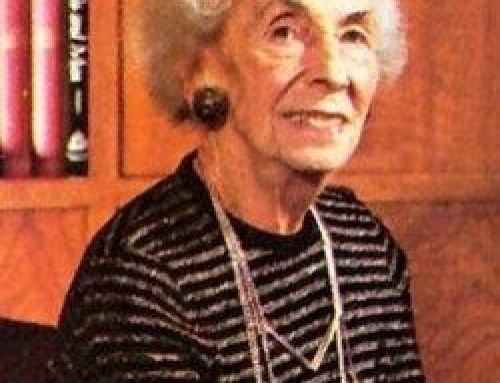

NAWA Luminary Theresa Ferber Bernstein-Meyerowitz (1890-2002)
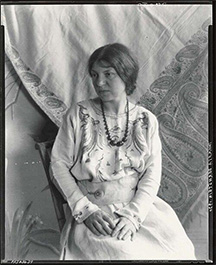
Theresa Ferber Bernstein-Meyerowitz, 1940, age 30. Wikipedia.
“One works a whole lifetime trying to bring out one’s talent, develop a new path, and achieve new horizons. Everyone who is interested in gathering experience and bringing it into a culmination has a feeling that their accomplishments will be an inspiration to others as well.”
Theresa Bernstein
NAWA’s exhibition She the People, commemorating the 250th Anniversary of the Declaration of Independence, was an opportunity to honor and celebrate the achievements of our distinguished American women artists. In an accompanying essay, I included the work of Theresa Bernstein, along with four more NAWA artists, Edith Bry, Augusta Savage, Anna Walinska, and Judith K. Brodsky, who played meaningful roles in advancing the Declaration’s principles, to remind us of the part our members have played.
Our exhibition coincided with the release of The Power of Her Paintbrush: The Story of Theresa Bernstein, Janice Hechter’s children’s book. The book, illustrated with moments from Bernstein’s life, is intended for kindergarten through third grade. Hechter’s intention is for the narrative to serve as an inspiring reminder to young readers, especially girls, that they can achieve anything they set their minds to and overcome obstacles without giving up.
By Susan M. Rostan, MFA, EdD
Theresa Ferber Bernstein was born in Kraków, Poland, on March 1, 1890, the only child of Isidore Bernstein, a Jewish textile manufacturer, and his wife, Anne (née Ferber) Bernstein, an accomplished pianist.1 The family emigrated to the United States in 1890 when Theresa was still an infant.2 Theresa showed an early interest in art, learning to draw and paint at a young age.3,4
Bernstein traveled to Europe with her mother during the summer of 1905, when she was fifteen. The culture she encountered left an impression.
Graduating from the William D. Kelley School in Philadelphia in June 1907, at the age of 17, she received a scholarship to the Philadelphia School of Design for Women, now Moore College of Art & Design5, where she studied with Harriet Sartain, Elliott Daingerfield, Henry B. Snell, and Daniel Garber.6,7 She graduated in 1911 with an award for general achievement. (The college would award her an honorary doctorate in 1992)8. She returned to Europe in 1911, where she encountered and was impressed by artists of the new Expressionist movement, such as Wassily Kandinsky, Franz Marc, and Edvard Munch.9
In 1912, she settled in Manhattan and enrolled at the Art Students League, where she took life and portraiture classes with William Merritt Chase.10
In 1913, Bernstein attended the Armory Show, the first large exhibition of modern art in America. Bernstein admired the style of Robert Henri, founder of the Ashcan School of American realism, and his way of depicting the everyday drama of the city.11 She was also influenced by John Sloan, Stuart Davis, and others of the movement.12 According to art historian Gail Levin, Bernstein was for a time more popular than well-known realist Edward Hopper, although Bernstein’s style over time tended more toward expressionism.13 However, unlike abstract artists, Bernstein remained committed to figuration, choosing always to connect with real life and people.14,15
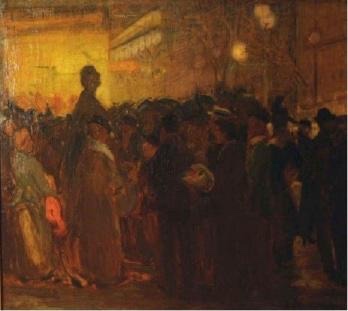
Theresa Bernstein, Suffrage Meeting, 1914, oil painting on canvas. The City University of New York
With an interest in the woman suffrage movement, she painted The Suffrage Meeting, which she exhibited at the Winter Exhibition of the National Academy of Design from December 1914 to January 1915. Bernstein was part of the Philadelphia Ten, an influential group of female artists, and in 1916 became a member of the National Association of Women Painters and Sculptors, winning the National Arts Club prize that year.
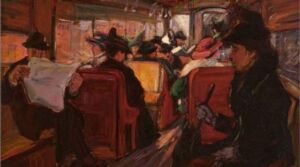
In the Elevated, 1916, oil on canvas. De Young Fine Arts Museum, San Francisco.
She met her future husband William Meyerowitz, also an artist, in 1917, and they married in Philadelphia on February 7, 1919. Their only child, Isadora, died in infancy, a story she would tell in her book William Meyerowitz: The Artist Speaks. She created her painting, Mother and Child, using a sepia photograph of herself holding baby Isadora.16
Bernstein took on students and began giving Louise Nevelson private watercolor lessons around this time.17 Bernstein and her husband, who were living in New York City, began spending summers in Gloucester, Massachusetts in the 1920s. In 1922, the couple traveled abroad together, spending five months there.
Bernstein continuously participated in the National Association of Women Painters and Sculptors’ annual exhibition, winning the National Association Prize in 1923. In 1924, she exhibited The Milliners (1918), depicting a group of women seated in a city apartment, sewing. The work, described as exploring community and concentration, also addresses the vibrancy and variety of immigrant and working-class experiences in 20th-century New York.18 It won the National Association of Women Painters and Sculptors John Clerici prize and $100 in 1924. Bernstein was also part of the Society of American Graphic Artists, and the North Shore Art Association. She exhibited extensively with the National Academy of Design and the Society of Independent Artists, which she co-founded.
In her paintings, Bernstein depicted the major issues of her time: the woman’s suffrage movement, World War I, jazz, the plight of immigrants, unemployment, and racial discrimination. She also painted portraits of her husband and other people, including Polish musician and politician Ignacy Jan Paderewski, jazz musician Charlie Parker, and entertainer Judy Garland. Her studio near Bryant Park and Times Square allowed her to paint a cross-section of New Yorkers, using large brushstrokes and bold colors to depict the vitality of her subjects.19 At Coney Island and later during her summers in Gloucester, she painted harbors, beaches, fish, and still lifes.
Early reviewers praised her “man’s vision,” while recent scholars have found that she had a “decidedly feminine sensibility.20 In the male-dominated art world of her time, Bernstein, like many women artists, was frequently overlooked. To avoid discrimination, she often signed her works as “T. Bernstein” or just her surname. 21,22
The Meyerowitzes presented themselves as a “painting couple.” At first, Bernstein’s sales and reviews were far better than her husband’s. Still, over time, her reputation waned as interest in realistic subjects waned.23,24 During the Great Depression, Bernstein and her husband continued to teach in their studios in Manhattan and Gloucester and sold graphics to supplement their income.
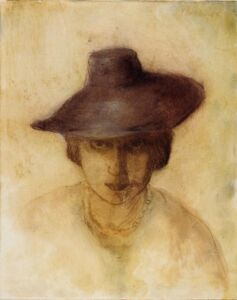
Self-portrait, 1947, color etching on paper. https://americanart.si.edu/artwork/self-portrait-1977
The couple became involved in the Zionist movement, and after the establishment of the State of Israel, they visited the country 13 times over 30 years. Until her husband died in 1981, Bernstein promoted his artwork while creating her own.
Bernstein and her husband lived for many decades in a rent-controlled loft-style studio apartment at 54 West 74th Street on the Upper West Side of Manhattan, just one block from Central Park West. This studio was her home at the time of her death on February 12, 2002, at Mount Sinai Hospital, shortly before her 112th birthday.
Theresa Bernstein’s seventy-six years of participating in NAWA’s annual exhibitions (1916-1992) is unprecedented. Beyond that are her numerous awards from the Association: The Joan of Arc Silver Medal Given for a Portrait in Oil of a Woman, for Tatania in 1928; The Margaret Cooper prize for Sarah in 1951, and the Doris Klein prize for Portrait of William Meyerowitz in 1977.
Her written work includes The Journal, published in 1991, when she was 101. Her artwork is held by several museums and other permanent collections, including: The Phillips Collection, The Jewish Museum, The National Gallery of Art, The Smithsonian American Art Museum, The Harvard Art Museums, The Metropolitan Museum of Art, The New York Public Library, and The Boca Raton Museum of Art in Florida.
In 2014, Theresa Bernstein: A Century in Art, a retrospective exhibition of 44 of her works from public and private collections, was organized by art historian and NAWA HVP Gail Levin at Franklin & Marshall College in Lancaster, Pennsylvania.
An extensive gallery of Bernstein’s paintings is available on the City University of New York website devoted to her life and work.
Susan M. Rostan, MFA, EdD
NAWA Signature Member
NAWA Historian
NAWA Luminaries
Sources:
https://archive.org/details/journal0000bern/page/124/mode/2up
18 https://www.artic.edu/artworks/253793/the-milliners
24 “Artist Celebrates 110th Birthday With Big Apple Show”. Art Business News. April 2000.
7, Bailey, Michael (February 15, 2002). “Theresa Bernstein at 111; Realist Painter, Author”. The Boston Globe.
1,4,8,23Burnham, Patricia M. (1988). “Theresa Bernstein”. Woman’s Art Journal. 9 (2): 22-27
22 de Angeli Walls, Nina (1999). “Review of The Philadelphia Ten: A Women’s Artist Group, 1917–1945”. The Pennsylvania Magazine of History and Biography. 123 (4): 389–391.
21Diament, Liz (March 19, 2021). “Theresa Bernstein Inside the New York Public Library”. National Gallery of Art.
10,20 Douglas Martin (February 16, 2002). “Theresa Bernstein, an Ash Can School Artist, Dies at 111”. The New York Times. p. A 17.
13,16 Durantine, Peter (Jan.15, 2014). Painter of the Century: Theresa Bernstein. Franklin & Marshall College.
11,15 Edelman, Aliza (2014). “Review of Theresa Bernstein: A Century in Art”. Woman’s Art Journal. 35 (2): 59–60.
8https://forward.com/culture/189491/why-theresa-bernstein-was-the-jewish-artist-of-the/
Hechter, Janice (2026).The Power of Her Paintbrush: The Story of Theresa Bernstein, Kar-Ben Publishing, Minneapolis, MN.
14 Heung, Elsie (March 29, 2012). “About Theresa Bernstein”. CUNY New Media Lab.
Levin, Gail (2013). Theresa Bernstein: A century in art. Lincoln: University of Nebraska
Press. Lincoln and London.
5, 9, 12, 17,19 Levin, Gail (2013) Forgotten Fame: Inscribing Theresa Bernstein into History, In Levin, Gail (Ed.) Theresa Bernstein: A Century in Art, University of Nebraska Press, Lincoln and London.
Prial, Dunstan (February 15, 2002). “Theresa Bernstein, 111, Modernist Painter”.
2 Theresa Ferber Bernstein. Artcyclopedia.com.
3. Theresa Bernstein (1890–2002). Jewish Virtual Library. American-Israeli Cooperative Enterprise.
6,20 Theresa Bernstein. Smithsonian American Art Museum.