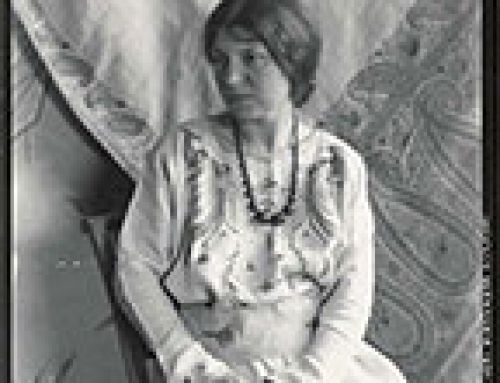

NAWA Luminary Edith Bry (1898 – 1991)
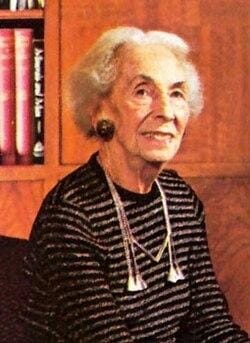
By Susan M. Rostan, MFA, EdD
NAWA’s exhibition She the People, commemorating the 250th Anniversary of the Declaration of Independence, is an opportunity to honor and celebrate the achievements of our distinguished American women artists. The work of Edith Bry, along with four more NAWA artists, Theresa Bernstein, Augusta Savage, Anna Walinska, and Judith K. Brodsky, who played meaningful roles in advancing the Declaration’s principles, introduces the exhibit of current Signature members.
Edith Bry’s lithograph entered NAWA’s exhibit through collector Richard L. Field. NAWA’s executive director, Jill Baratta, made the introduction, and we had a lovely phone conversation. He had been collecting art and acquired a lithograph of hers.
Opening the New York City phonebook, he found her name, called, and her nurse, Ann, answered and said to come over to her apartment at the Beresford on Central Park West. When he arrived at the building, the elevator took him straight up to her stunning apartment, which occupied an entire floor. He was taken by the interior, noticing the wood mantle she had carved. They chatted, and Field noted that “She threw me out when she said she wanted to watch the ball game,” adding, “I was young, and she was elderly, and she gave me a catalog from a retrospective she had at NYU’s Loeb Student Center. Since then, I have five lithographs.” Field was kind enough to share Bry’s work.
Bry worked across a remarkable range of media — oils, watercolors, graphite, crayon, lithographs, woodcuts, etchings, wood carving, mosaics, and large-scale fused glass and enamel works. Her style evolved from social realism toward abstract expressionism, though her subjects remained discernible, if sometimes only on close inspection. The shift was never strictly linear; she continued producing realist work well into her later years. Critics noted a productive tension in her art between inner restraint and bold expressionism—a quality evident across both modes. Throughout her work, she engaged with politics, ethics, and culture, finding fragility in fleeting moments and inviting viewers’ quiet contemplation.
Edith Bry was born on November 30, 1898, in St. Louis, Missouri, into a family whose prosperity came from department stores and clothing manufacturing. When she was about eight, her parents, Louis and Melanie Bry, relocated to New York City, and her father’s continued success soon afforded them something invaluable before the outbreak of World War I: travel. The Brys made it to Europe, and visits to museums in Paris and Madrid changed the course of Edith’s life. She came home with postcards and began teaching herself to draw by copying them.
After graduating from high school in 1917, she enrolled at the Art Students League, studying with Alexander Archipenko, J. Alden Weir, Winold Reiss, Charles Locke, and Guy Pène du Bois. When the war ended, she headed to Germany and studied briefly with Hermann Struck and Siegfried Laboschin. Returning to New York, she took private lessons with Abe Rattner.
She married Maurice Shevelson Benjamin, an engineer and founder of a brokerage firm, in 1921, and their only child, Bry Benjamin, was born three years later. She kept working and, in 1927, she had a solo show of celebrity portraits and abstractions she called “imaginative creations” in a gallery in Corsicana, Texas. She told a reporter that expressing her feelings in the abstractions helped her to overcome depression and “turbulent moods.”1
A year later, the New York Post included her portrait of the American critic and biographer, Carl Van Doren, in its Saturday Gravure section, and the newly founded Opportunity Gallery in New York included two of her drawings in its exhibit. The gallery, located in the Art Center on East 56th Street in Manhattan, offered free exhibition space to new artists and made no profit from the sale of their work.
In 1929, the family moved to a large apartment on an upper floor in the newly opened Beresford building on Central Park West. Together with the well-known architect Ely Jacques Kahn, Edith designed an Art Deco-style living space. Bry carved the wood panel over the fireplace in the library.
Bry married Maurice Shevelson Benjamin, an engineer and founder of a brokerage firm, in 1921, and their only child, Bry Benjamin, was born three years later.
She kept working and, in 1927, she had a solo show of celebrity portraits and abstractions she called “imaginative creations” in a gallery in Corsicana, Texas. She told a reporter that expressing her feelings in the abstractions helped her to overcome depression and “turbulent moods.”1
A year later, the New York Post included her portrait of the American critic and biographer, Carl Van Doren, in its Saturday Gravure section, and the newly founded Opportunity Gallery in New York included two of her drawings in its exhibit. The gallery, located in the Art Center on East 56th Street in Manhattan, offered free exhibition space to new artists and made no profit from the sale of their work.
In 1929, the family moved to a large apartment on an upper floor in the newly opened Beresford building on Central Park West. Together with the well-known architect Ely Jacques Kahn, Edith designed an Art Deco-style living space. Bry carved the wood panel over the fireplace in the library.
Bry continued to exhibit in group shows at the Opportunity Gallery, and in 1932, she exhibited with two other women in the G.R.D. Gallery. A critic for The New York Times praised her still lifes for their “knowing technique” and appreciated her enigmatic titles, for instance, “Atavic,” for a still life of red cabbage, beets, and eggplant.2
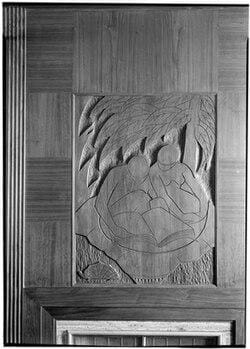
Photo of the carved panel over the fireplace in the library of her home at the Beresford. https://en.wikipedia.org/wiki/Edith_Bry
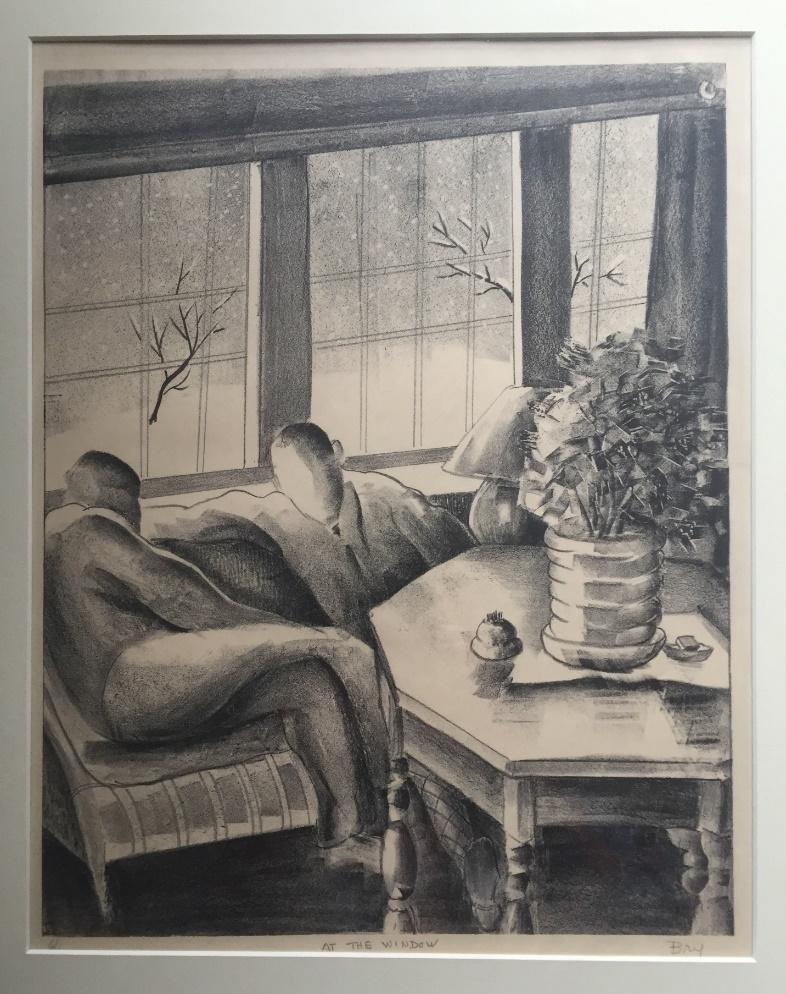
Edith Bry, At the Window (6/6), circa 1932, lithograph, 12-3/4″ x 10-1/4″, courtesy of Richard L. Field.
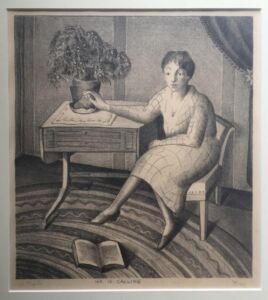
Edith Bry, He Is Calling (10 prints), circa 1932, lithograph, 9-3/8″ x 8-1/2″, courtesy of Richard L. Field.
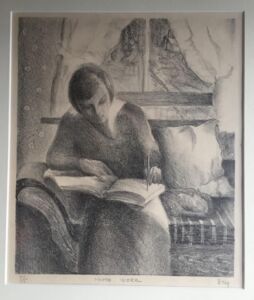
Edith Bry, Home Work (5/5), circa 1932, lithograph, 9-3/8″ x 8″, courtesy of Richard L. Field.
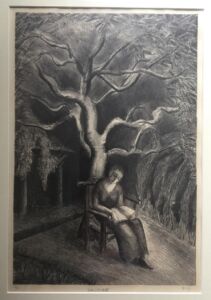
Edith Bry, Solitude (2/10), circa 1932, lithograph, 14″ x 9-3/8″, courtesy of Richard L. Field.
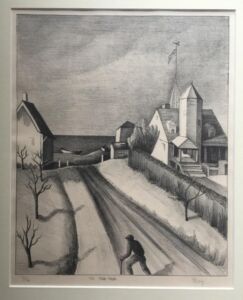
Edith Bry, To the Sea (Coast Guard House – West End, NJ), circa 1932, lithograph, (9/12) 10-3/4″ x 8-3/4″, courtesy of Richard L. Field.
A few years later, in 1935, Howard Devree, of The New York Times praised her “growth in compositional conception, and advance in paint values…and gratifying sureness of approach”3 and a critic for the New York Post said she had a flair for composition: “she places the objects in her still lifes in pleasing relations of form and space; the flowers in her bouquets have a spacial existence, air flows between the blossoms and around them.”4
She began participating in the annual membership shows of the National Association of Women Painters and Sculptors in 1935, exhibiting paintings, both oil and watercolor, and lithographs. When she showed line drawings in a 1935 exhibition at the Association’s Argent Galleries, a critic praised her skill, writing that her “drawings might bid Picasso look to his laurels.”5
In October 1935, Bry had a solo exhibition of oil paintings at a gallery in St. Louis. A notice of the show in the St. Louis Star drew attention to her versatility, noting: “Her output is large, not only in oil, but in etching, lithography, wood carving, and sanguine crayon.” 6
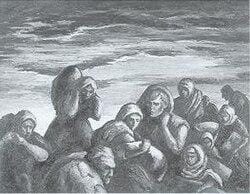
Edith Bry, Exiled, 1936, lithograph, 9 × 11 7/8 inches. https://en.wikipedia.org/wiki/Edith_Bry
In 1937, Bry exhibited a lithograph titled “Exiled” in the International Print Makers Exhibition at the Los Angeles Museum. The Los Angeles Times headlined its article on the show with a reproduction of the print, and its critic called it “grim.”7 This 1936 lithograph and a 1937 painting she made of the same scene were later purchased by the Metropolitan Museum of Art. That same year, she joined the nonprofit Studio Guild, where she exhibited and helped to arrange Guild-sponsored events that raised money for overseas relief work.
In 1938, she organized the sale of works donated by 130 artists to raise funds for the Joint Distribution Committee. This Jewish relief organization, based in New York City, helped European Jews escape Nazi persecution.
A year later, she contributed works to a Guild exhibition that circulated among museums and galleries around the country. In 1940, when the Metropolitan Museum of Art exhibited “Exiled,” a New York Sun reporter interviewed Bry. In the interview, she said she intended the painting to convey a sense of finality and doom. While she recognized that it was topical, she said she had not intended it to be propagandistic.8
Bry was included in the 1940-41 Annual Exhibition of Contemporary American Painting at the Whitney Museum of American Art and, that same year, became active in an artists’ advocacy group called the Federation of Modern Painters and Sculptors. A group of New York artists formed the Federation, primarily Mark Rothko and Adolph Gottlieb, as well as Milton Avery, Meyer Schapiro, Ilya Bolotowsky, Isabel Bishop, Dorothy Eisner (NAWA 1938), and Anne Goldthwaite (NAWA 1915). All had resigned from the American Artists’ Congress to protest its Nazi influences and “Stalinist line” after the congress had endorsed the Soviet invasion of Finland. Bry served as the Federation’s recording secretary and vice president, and in 1945 was elected its president. She showed in its first and subsequent annual exhibitions, as well as in special exhibitions.9 Her collage, Equations, in the 35th annual exhibition of 1976, may have been her last, in a commitment lasting thirty-six years.10
She continued to participate in group exhibitions during the war years, and also volunteered for war-related work: teaching art classes for wounded soldiers; making war bond posters and skin-draft drawings for a plastic surgeon; and, in 1945, painting irises for artificial eyes.
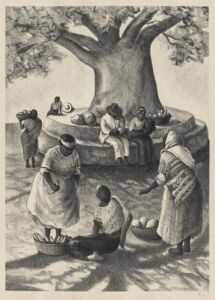
Edith Bry, Palin, 1945, lithograph on paper. https://americanart.si.edu/artist/edith-bry-32353
Edith Bry had traveled to Guatemala before the war, and the experience became the source of much of her later work. Working from her sketches, she subsequently made a lithograph titled Palin, depicting Guatemalan Indians grouped around a Ceiba tree, commissioned by the commercial gallery Associated American Artists.
After the war, Bry became less focused on representation, seeking to capture emotion through landscapes drenched in light and color. She traveled globally, visiting Mexico, Central and South America, Spain, and the African continent. In these post-war years, she continued to show oils, watercolors, and prints in group exhibitions held by the associations of which she was a member, including NAWA, where she exhibited in most of NAWA’s annual exhibitions through 1969. Bry continued to attract the attention of art critics, who noted her versatility, pointing to her skill in oil painting, lithography, etching, drawing, watercolor, and wood carving. One critic called her style a “discipline of an inner reticence” to a “more dynamic emotional expressionism.”11
A solo exhibition in 1951 at the John Heller Gallery drew critics’ attention for what one called a shift in her work from “visual sobriety” to expressionistic feeling: “… the emotional turmoils that seethe in vivid reds and blues, and in angry, slashing brushwork on the surfaces of her canvases are often staged at the expense of pictorial coherence. Her subjects, many of them religiously inspired, are obviously deeply felt, which is their first claim to attention.” 12 Bry explained the transition as an effort to free herself from the “tyranny of nature.” 13
In the late 1950s, Bry began experimenting with works in fused glass and vitreous enamel, and thereafter made fused glass panels mainly for places of worship, like the pieces installed at the Central Synagogue and the Park Avenue Synagogue in Manhattan, and at the Second Reformed Church in Tarrytown, N.Y., as well as collage. The Loeb Student Art Center at New York University held a retrospective exhibition of her work in 1983.
Bry continued to live and work in New York until her death on January 19, 1991, at the age of 92, bringing to an end a career that spanned 75 years.
Edith Bry’s work is represented in the Georgia Museum of Art, University of Georgia, Athens; the Indianapolis Museum of Art, Indiana; the Metropolitan Museum of Art and the New York Public Library, New York; the Hunter Museum of Art, Chattanooga, Tennessee; and the Library of Congress and the National Gallery of Art, Washington, D.C.
Sources:
1“Express Moods in Modern Painting.” Corsicana Daily Sun. via AP (1927-0430). Corsicana, Texas.
3 Howard Devree (1935-04-07). “The American Scene by George Picken”. The New York Times. p. X8
4 Edith Bry’s Exhibit at the Grant Gallery”. The New York Post. 1935-04-06.
5“Various Exhibits of the Week’s Calendar”. The New York Post. 1935-05-31.
6 “Edith Bry to Hold ‘One-Man’ Exhibit of Oil Paintings”. St. Louis Star and Times. 1935-10-12. p. 9.
7 Arthur Millier (1937-03-07). “Americans, British Show Prints”. Los Angeles Times. p. 65.
8 Museum Shows Bry Painting; 1 of 21 by Contemporary American Artists”. New York Sun. 1940-08-24. p. 15.
9 Jules Heller; Nancy G. Heller (2013). North American Women Artists of the Twentieth Century: A Biographical Dictionary. Taylor & Francis. pp. 323–325.
10Maybelle Mann (1976-07-17). “Painters and Sculptors Show Opens”. Times Herald Record. Middletown, New York. p. 24.
11″ Art of Edith Bry Causes Controversy by Critics”. Kingsport Times. Kingsport, Tennessee. 1953-11-22. p. B7.
12 “Art Shows Thrive in Galleries Here: One-Man and Group Displays on View in Number—Bry’s Paintings Are Exhibited”. The New York Times. 1951-09-14. p. 26.
13 Paul Mocsanyi (1951-10-17). “New York Artist Found Emotional Freedom in Color.” Indianapolis Star. P. 89.
https://americanart.si.edu/artist/edith-bry-32353
https://www.annexgalleries.com/artists/biography/5216/Bry/Edith
https://archive.org/details/194041annual00whit
https://design-encyclopedia.com/?T=Edith%20Bry
Museum Shows Bry Painting; 1 of 21 by Contemporary American Artists. New York Sun. 1940-08-24. p. 15.
https://www.nga.gov/artists/33247-edith-bry
https://www.si.edu/object/archives/components/sova-aaa-bryeditp-ref1
https://whitney.org/exhibitions/annual-1940-2
https://en.wikipedia.org/wiki/Edith_Bry
https://www.wikiwand.com/en/Edith_Bry
Susan M. Rostan, M.F.A., Ed.D. Website
Historian, NAWA Historical Research, NAWA Luminaries
Email: NAWA Historian
Signature Member of the National Association of Women Artists
NAWA. Empowering Women Artists Since 1889