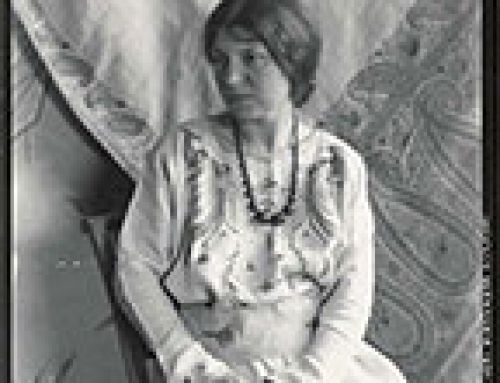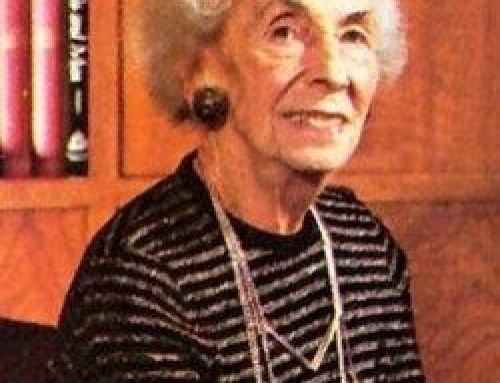

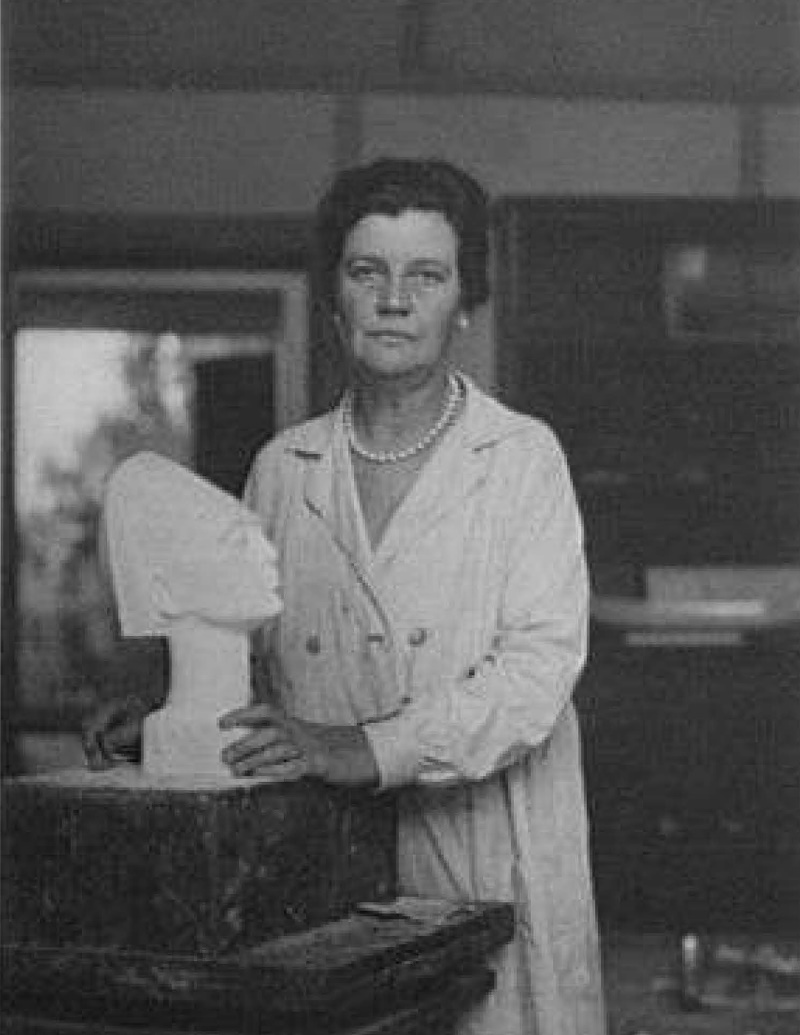
Maude Sherwood Jewett, c. 1934. Courtesy of Gray Shay 1857.
Maude Sherwood Jewett was born to Col. John D. and Emmaline C. (Zimmerman) Sherwood in Englewood, New Jersey, on June 6, 1873. Her father, a graduate of Yale and Harvard Law School, was an established New York City lawyer and renowned writer. The family lived in a stone villa, Stone Lodge, designed by her father. She grew up in a somewhat affluent, cultured environment, with access to a segment of upwardly mobile society. Her engagement in cultured social circles is evidenced by her participation in the Englewood Country Club Ladies’ Doubles Tennis Tournament, held July 9, 1892. It is likely through events such as these that Maude Sherwood came into contact with her future husband, Edward Hull Jewett (1899-1981), the son of stockbroker Charles Henry Jewett. By 1895, they married and continued to live in Englewood, NJ, while Edward worked as a stockbroker.1
It was during this time that she was also developing as an artist. Before 1900, she had already begun making a name for herself in the artistic world as a sculptress. A graduate of the Art Students League, she studied with Harriet Whitney Frishmuth, whose influence is evident in the fact that both the student and the teacher created several sundials and fountains, and in the 1920s, small bronze flower holders.
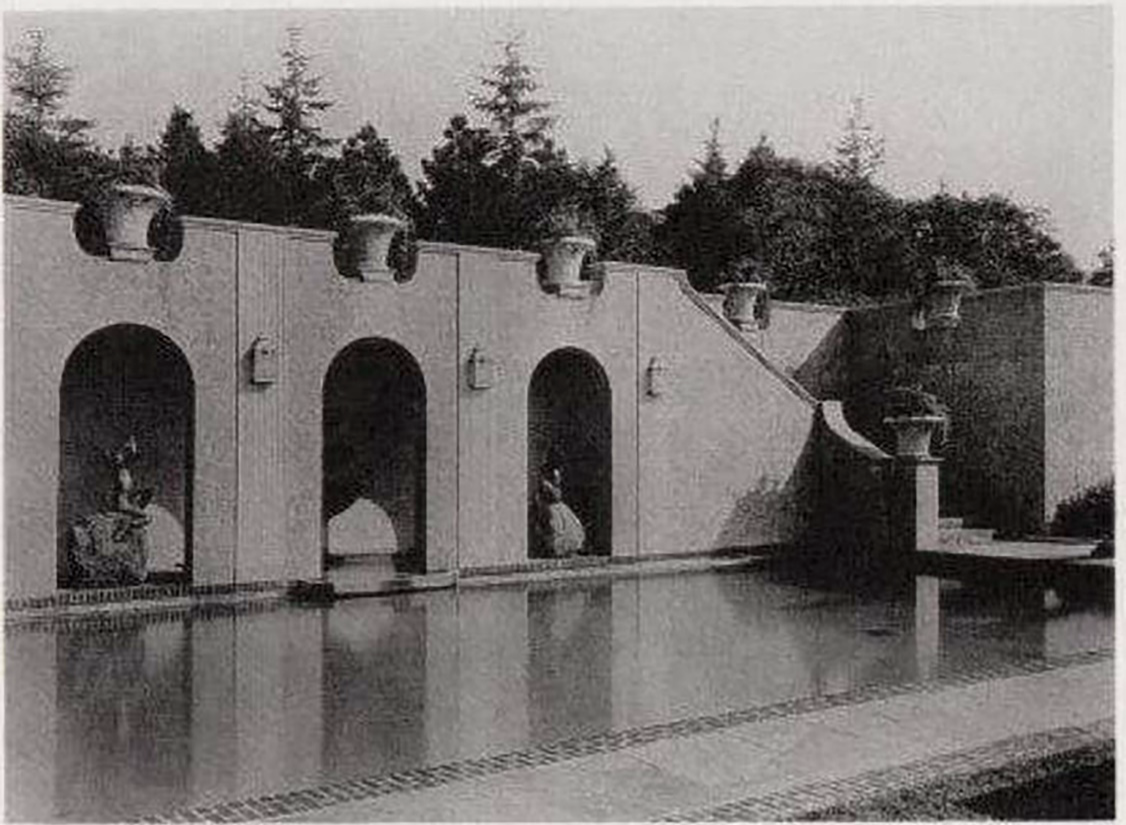
Maude Sherwood Jewett, c. 1928, Piping Pan and Midsummer. Courtesy of Graham Shay 1857.
Jewett had two children with her husband, Edward: Edward Jr. and John Howard (1902-1986). John Howard would become an architect, remembering how, as a child, he’d ‘help’ each year when his mother pulled out calligraphy pens and ink to draw her own holiday cards.2
While the family lived in New Jersey, Jewett maintained a studio in New York City from 1910 through 1930 and exhibited at the Macbeth Gallery. Beginning around 1912, she kept a summer cottage in East Hampton, New York, called the “Ink Pot,”its shape resembling the ink container for a quill pen. Situated in a semi-rural stretch of Long Island, the home, with its ocean view and sunken gardens, became her new studio, and she decorated the grounds with her own work. It was a gathering place for local artists and high society for decades. A charter member of Guild Hall in East Hampton, she served as the Art Committee’s first chairman.
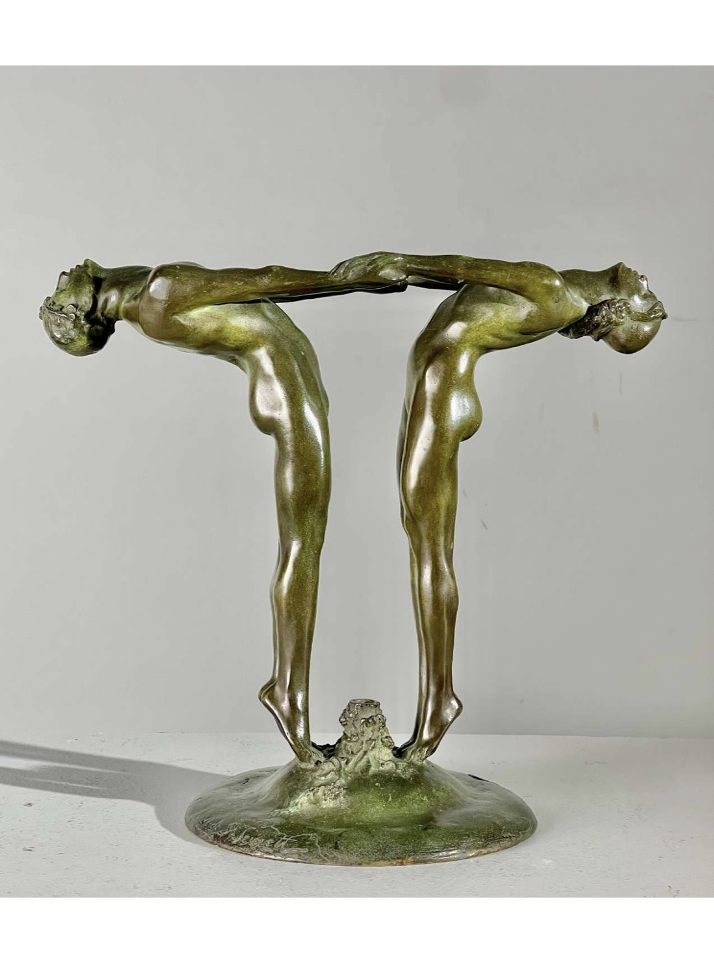
Maude Sherwood Jewett, Flower Holder, 1924, Bronze, courtesy Graham Shay 1857
Jewett joined the National Association of Women Painters and Sculptors in 1918 and was also a member of the American Federation of Arts and the American Artists Professional League. She exhibited at the National Sculpture Society in 1923 with a fountain figure titled The Young Sun-Worshipper, and at the annual exhibitions of the National Association of Women Painters and Sculptors until 1925.
Jewett also created slender dancing figures, such as the 1924 bronze flower holder, consisting of two figures on tiptoe holding hands and leaning back as they appear to whirl. The work shows the influence of the sculptor’s teacher, Frishmuth, whose work is also known for lithe, slender dancers and the Art Deco characteristic slickness of surface, smoothness of idealized forms, and stylized poses.3
The charm of her garden pieces is evident in vintage photographs of the Major Fullerton Weaver estate in East Hampton.4 The bronze Piping Pan and a companion figure, Midsummer, are seated in wall niches alongside the estate’s swimming pool.
Jewett designed the World War I Soldiers and Sailors Memorial, installed in 1924 on East Hampton’s Memorial Green. Robert Baillie (1880-1961), a sculptor from New Jersey, carved Jewett’s design, and William A. Lockwood (1874-1966), a lawyer and summer resident, wrote the inscription. To this day, a decorated monument is part of East Hampton’s Memorial Day observances.5
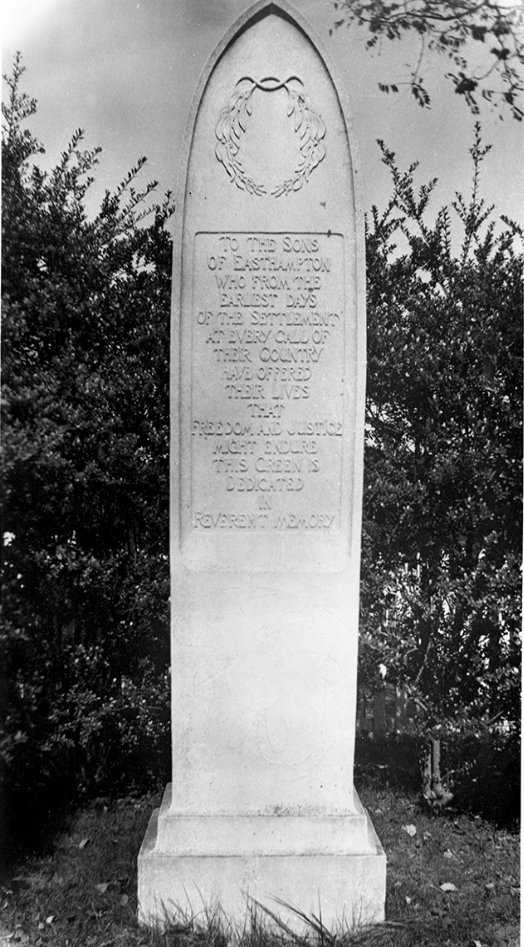
Maude Sherwood Jewett, Soldiers and Sailors Memorial, 1924.
Active in club and community life, in 1931, she organized a highly acclaimed exhibition dedicated to The Tile Club and its followers in East Hampton. This group of historical residents of the East End community included Winslow Homer, William Merritt Chase, John Henry Twachtman, Elihu Vedder, Augustus Saint-Gaudens, and Stanford White.6
In 1948, Jewett created souvenir ceramic bells for the East Hampton Town tricentennial anniversary. Around the bell, she etched drawings of a windmill, a saltbox house, and Clinton Academy, where she and other turn-of-the-century summer colony artists used to show their work. A whale atop serves as the handle, and the dates of the town’s founding and anniversary (1648 and 1948) encircle the base with the words “Long Island.” Approximately 300 bells are believed to have been produced.7
Maude Sherwood Jewett was on a cross-country train trip heading back to East Hampton from San Francisco when she had a stroke on March 9, 1953. She died in a Southampton nursing home on April 16, 1953.
Jewett’s sculptures, particularly those designed for gardens, can be seen at the Cleveland Museum of Art, and one, a full-size bronze sculpture of Pan, is on display behind the Historical Society in East Hampton, L.I., New York.
Sources:
A NEW EXHIBITION GALLERY AT EASTHAMPTON, L.I. (1931). The American Magazine of Art 23(4),-341. http://www.jstor.org/stable/23938539
https://ancestors.familysearch.org/en/LTK4-HL1/maude-a-sherwood-1873-1953
https://archive.org/details/americanwomenscu0000rubi/page/100/mode/1up. Charlotte Streifer Rubinstein (1990). American women sculptors: a history of women working in three dimensions. G.K. Hall. ISBN 978-0-8161-8732-4.
https://www.askart.com/artist/Maude_Sherwood_Jewett/89945/Maude_Sherwood_Jewett.aspx
2https://www.easthamptonstar.com/villages/20191219/christmas-greetings-jack-jewett
1,7https://jewett.org/jfa_backissues/jfa_quarterly_2011_3.pdf
5https://www.easthamptonstar.com/villages/2023525/item-week-east-hampton-war-memorial
3,4Three Unique Works by Two Women Artists: Maude Jewett and Harriet Frishmuth. Email, Graham Shay1857.
Guild Hall of East Hampton: An Adventure in the Arts, the First 60 Years. Guild Hall of East Hampton. 1993. ISBN 978-0-8109-3384-2.
Jules Heller; Nancy G. Heller (December 19 2013). North American Women Artists of the Twentieth Century: A Biographical Dictionary. Routledge. ISBN 978-1-135-63882-5.
The National Cyclopaedia of American Biography: Current. J.T. White. 1927.
https://youtu.be/JPvr-qupiFk?si=DoFzg8atVeDkeeOe
John Warden Rae (2000). East Hampton. Arcadia Publishing. pp. 85–. ISBN 978-0-7385-0401-8.
https://en.wikipedia.org/wiki/Maude_Sherwood_Jewett
https://www.wikiwand.com/en/articles/Maude_Sherwood_Jewett
Susan M. Rostan, M.F.A., Ed.D. Website
Historian, NAWA Historical Research, NAWA Luminaries
Email: NAWA Historian
Signature Member of the National Association of Women Artists
NAWA. Empowering Women Artists Since 1889<