FEATURES
By Jen Haefeli
The Harlem Renaissance released the soul, the spirit, and the energy of Black culture for the world to experience. The stories behind the Renaissance are told through art, dance, music, and poetry, and they speak of freedom and the tenacity of the human spirit. Like a lightning rod sending jolts of syncopated rhythm and joy reverberating from the earth to the sky, artists were conduits of energy who opened themselves to let the gift of creativity flow. These artists, dancers, musicians, poets, and writers became the agents of change, and the world received a new gift – a renaissance in Harlem.
The Smithsonian Associates’ “Artists of the Harlem Renaissance”, a lecture presented by art historian LaNitra Berger, provided an overview of the culture of the time, the impact of the visual arts, and a synopsis of the founding of this movement.
The Harlem Renaissance, though largely concentrated in Harlem, New York, has become more than the timeframe it was born from. The concentration of creativity and the culmination of events that occurred between 1918 and 1940, by those who were motivated to express themselves creatively, lives on. A genre was birthed, the impact of which has reverberated worldwide. The intellectual convergence and cultural celebration experienced in Harlem burst to life in other major cities in the United States as well. Nonetheless, all eyes were on Harlem, a small but intensely influential geographic area in New York, just about three square miles in size. Harlem was home to several well-known nightclubs, playhouses, and cabarets popularized by headlining jazz musicians, music companies, world-renowned singers, and dancers that kept the presses pumping out news. African Americans defined what Black culture was rather than allowing the racist tropes of southern enslavement to tell the story on their behalf.
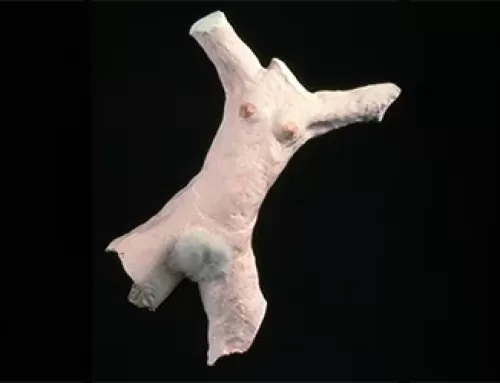
Listening to Ms. Berger’s account, the leaders sounded like a box of creative matches that lit and grew into a flame that kept burning, each lighting the next throughout the world. Social Realist Jacob Lawrence was known for documenting the African American Experience. His expressive, cubist style was referred to as “visionary”. Poet, painter, sculptor, and theatre designer, Meta Warrick Fuller, known for her life-size works, particularly her piece, “Ethiopia Awakening”, was the first African American woman to receive a commission from the U.S. government for her dioramas of the events of the 1907 Jamestown Tercentennial Exposition. Sculptor and educator Augusta Savage is known as a “Renaissance Woman.” She became one of the most influential artists of the 20th century. Documentarian photographer James Van Der Zee’s work is considered the most comprehensive collection of photographs taken during the Harlem Renaissance. His portfolio is like a visual time capsule. These artists certainly left an indelible fingerprint.
The Great Migration created an unprecedented blossoming of creativity resulting from the relocation of hundreds of thousands of African Americans from southern states to the northern United States. The Black Pride movement, natural disasters in the south, and the establishment of the NAACP aided in priming the foundation for the culmination of talent to come. African Americans not only redefined the identity of Black culture but also established a new space in the world of creativity. An indelible genre that took the world by storm was ushered in, known as the “Jazz Age”. Harlem was the epicenter of this new cultural sovereignty.
The importance of this phenomenon cannot be understated. Black excellence celebrated globally is a triumph to honor. History looks to well-known names like W.E.B. Dubois, Langston Hughes, Zora Neale Hurston, and perhaps one of my all-time favorite artists, Louis Armstrong. If not for Satchmo, our world would be missing a depth of warmth and comfort that is reached only by his incredibly melodic, poetic embrace of words. Digging deeper into the layers of inspiration and creativity taking place at the time, there is no shortage of powerful and strong women one could focus on. However, despite living in an information age of pocket computers, we are experiencing more “404 error” pages as time passes.
Creators went unrecognized for far too long. Their work was undermined, undervalued, and dismissed due to their melanin. Female black fine artists experienced new opportunities during the Harlem Renaissance, a time of deep racial divide in this country. Lest we lose these inspiring women to the dregs of time and erasure from the internet, commit this knowledge to your memory. Speak about it. Share it. Remember them.
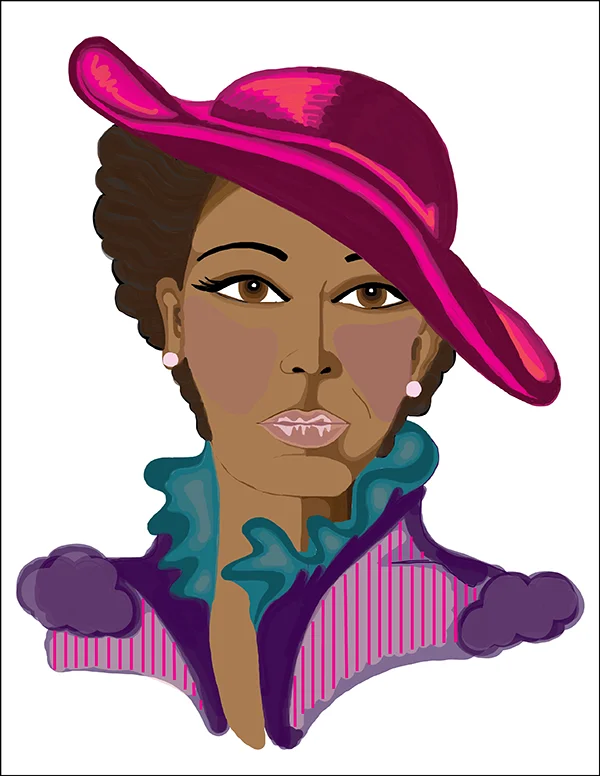
Josephine Baker: Mother of Rainbows, Digital Painting, 2022
Josephine Baker, a groundbreaking Vaudeville dancer, born in St. Louis, Missouri, made her way to Harlem, and as it is said, the rest is history. With a shimmy and shake, she danced her way around the world. She utilized her feminine powers of distraction to transport information for Allied troops on sheet music using invisible ink. Her banana skirt likely distracted them. Upon returning to the States, she faced abject racism despite being a war hero.
Many don’t think of Josephine as the “Mother of the ‘Rainbow Tribe”, her 13 adopted children. Some may not know that she had children. However, Josephine adored being a mother. She traveled the world, performing and entertaining, a symbol of the Jazz Age. Josephine’s work was improvisational, comedic, sensual, rhythmically soulful. Her popularity and energy matched the time, and it allowed her to help promote other performers. When Josephine took to the stage, she easily captured the crowd’s attention, and they listened. She quickly became a global phenomenon, and she used this popularity to influence Civil Rights activism and advocate for the French Resistance. She was awarded the Legion of Honour with the rosette of the Résistance and the Croix de Guerre for her agency during World War II, proving that she was more than a cheeky, sensual Jazz dancer.
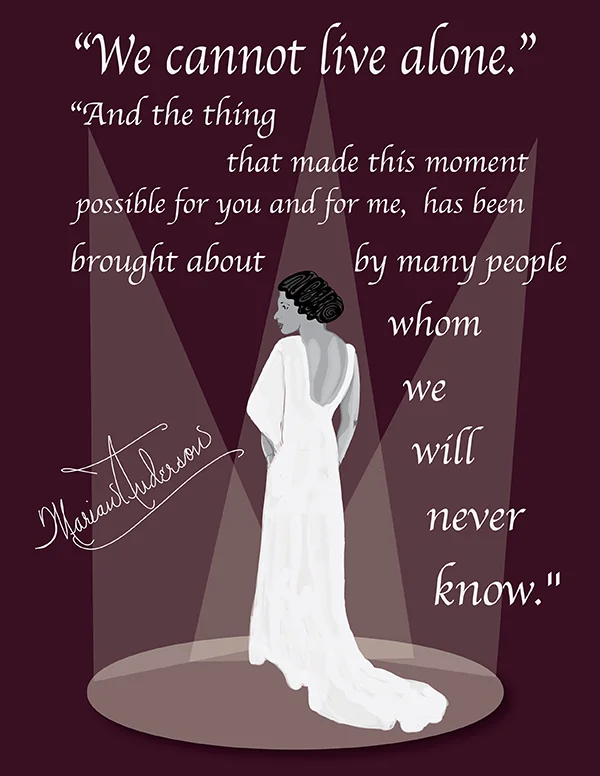
Marian Anderson: Limelight, Digital Painting, 2022
Marian Anderson was a cultural icon. She was a world-renowned, classically trained vocalist with an outstanding voice who challenged barriers and conquered hate. In 1928, Marian performed for the first time at Carnegie Hall. Within 10 years, Europe fawned over her. Italian Conductor Arturo Toscani described her as having a “Once in a Century Voice.”
When she was denied an opportunity to perform at Constitution Hall in Washington, D.C., which was owned by the Daughters of the American Revolution (DAR), First Lady Eleanor Roosevelt resigned from her DAR position over this egregious act. She then helped arrange an opportunity for Marian to perform on Easter Sunday in front of the Lincoln Memorial, where an audience of more than 75,000 people gathered to hear her. Marian’s performance was broadcast live on the radio to millions.
Marian contributed to the performing arts of the Harlem Renaissance, but her tenacity to also remain present in the conservatively classical spaces within the musical arts in the latter years of the renaissance garnered a unique respect for her talent. Marian became the first African American to perform as a member of the Metropolitan Opera in 1955. She worked with the State Department as a Goodwill Ambassador, performing in concerts worldwide. She also served as a United Nations Human Rights delegate.
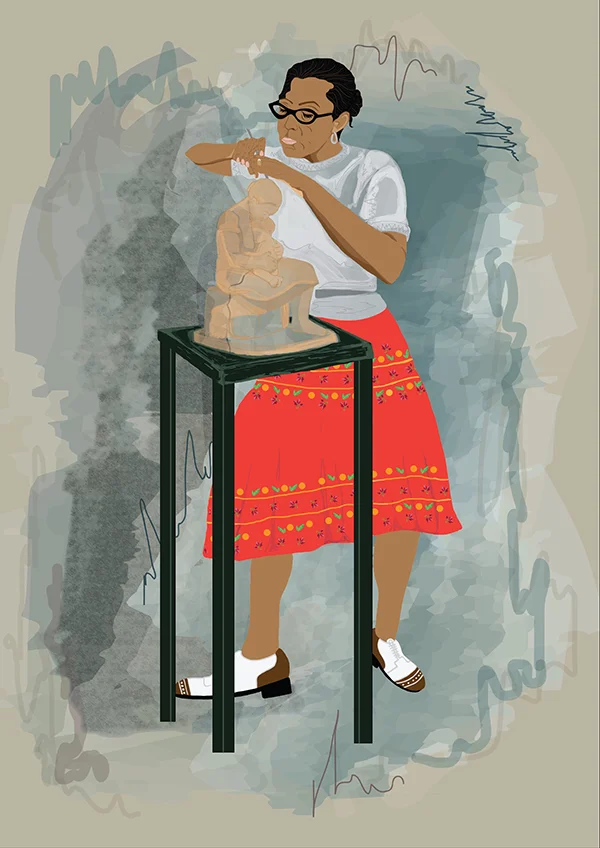
Elizabeth Catlett:, Mothering the Mothers, Digital Painting & Illustration, 2023
Born in Washington, D.C., Elizabeth Catlett grew up knowing stories of her grandparents’ enslavement. This was highly influential in her work. She received her BA in Art from Howard University and became the first woman to graduate from the University of Iowa with an MFA in Sculpture. She taught at the George Washington Carver School in Harlem. She was an influential fine artist in Harlem in the 1940s. She created an impressive catalog of unprecedented works. Elizabeth captured moments in life, such as the tender nature of mother and child. Her work contains wonderful storyline features and fleeting moments sealed in time.
In the 1950s, Elizabeth was exiled from the United States due to the nature of the political content she utilized in her work. She relocated to Mexico, where she lived for 60 years, becoming a Mexican citizen. In Mexico City, she worked with artists such as Diego Rivera, and as a professor at the National School of Fine Arts at National Autonomous University of Mexico, where she taught Sculpture. She was strongly inspired by the African influence in Mexican art, and after she returned to the U.S. for a solo exhibition in Harlem in 1971, though she had been granted a visa and her citizenship was reinstated, she opted to remain in Mexico for the rest of her life.
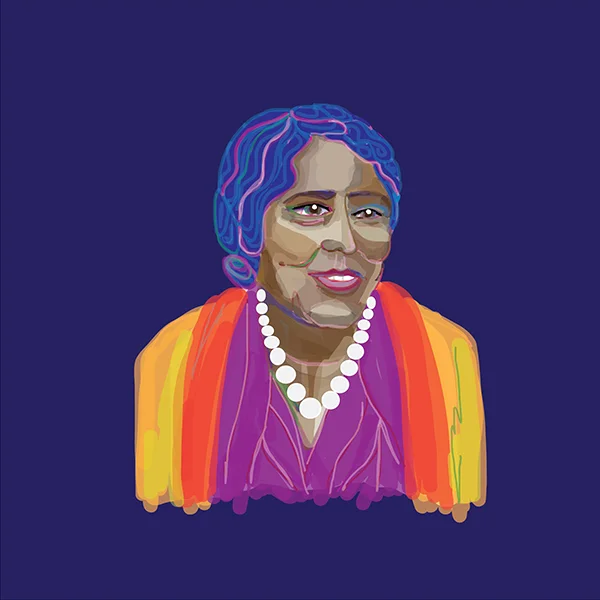
Gwendolyn Bennett: Advancing, Digital Painting, 2022
Gwendolyn Bennet’s work was published in journals and anthologies. She was a poet, a short-story writer, a columnist, a journalist, and a non-fiction writer. She was also an illustrator, graphic artist, arts educator, and teacher. She worked for the Federal Writers Project, and she was an administrator with the New York City Works Progress Administration Federal Arts Project from 1935–1941. As an educator, she set a higher standard.
Gwendolyn chronicled the events of the Harlem Renaissance in art, poetry, and prose, and she dedicated herself to exploring the impact of race and gender, interracial relationships, and the class structure of the time. Though poets had rarely touched the subject, Gwendolyn wrote about lesbianism, despite the condemnation, inspiring others with her dynamic work. Gwendolyn’s interracial marriage and experience moving to a southern region post-Great Migration provided her with a complex and in-depth perspective that influenced her work.
Gwendolyn’s vast experiences inspired her creativity. Born in Texas, educated in Paris, she had powerful innovation. The magazine “Fire!!”, some say, was a landmark creation, though it only had one edition. Gwendolyn served as the co-founder and editor of the publication, and although it was short-lived, she established a think-tank network and served on an editorial board, advancing young talent. She established Harlem Circles, which resulted in the production of some of Harlem’s most creative and influential work.
Following the loss of her home and her first husband, Gwendolyn remarried and moved back to New York after living in Florida and Long Island. Returning to the north provided opportunities to continue to advocate. She became a strong influencer who persistently invested in advancing African American women’s rights and education. Her investment was honored by the Women’s Service League of Brooklyn with its “Distinguished Woman of Today” award in 1939.
Though her cultural benefaction is largely slighted, Gwendolyn’s contributions to the success of the Harlem Renaissance are considerable. Gwendolyn’s advocacy and involvement are evident throughout the evolution of the Harlem Renaissance. She led the Harlem Community Art Center and was a member of the Harlem Artists Guild. She served on the board of the Negro Playwrights Guild and helped develop the George Washington Carver Community School.
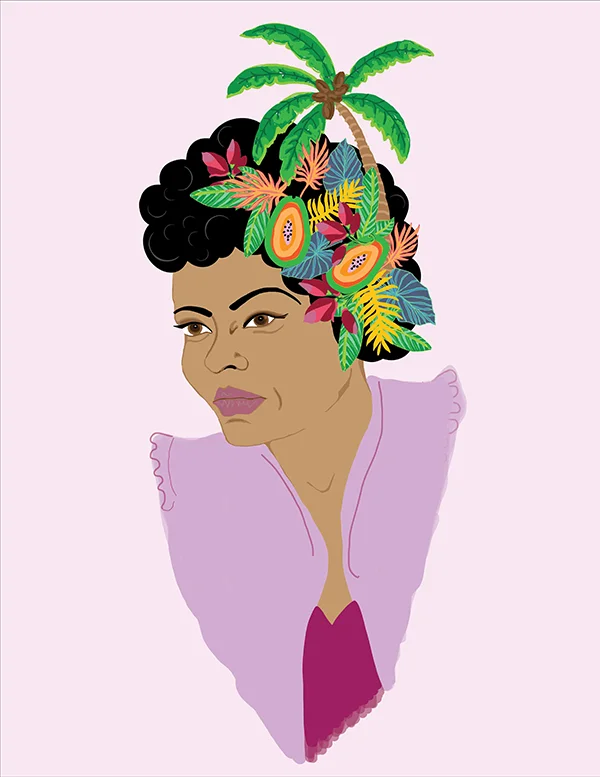
Billie Holiday: Poetic Songstress, Digital Painting & Illustration, 2022
Billie Holiday, jazz pioneer and vocalist, known as “Lady Day”, was an inspiration. She sang from an emotional place, often collaborating with other artists, delivering poetic, improvised performances frequently on the subject of anti-lynching. Billie, who was from Philadelphia, had a range covering jazz to swing, and everything in between. She was influenced by jazz, and she changed the tempo rather than following it.
During the 1930s, Billie performed with an all-white jazz band in Harlem, elevating the iconic image of standardized performance. She confronted racism by placing a magnolia in her hair, donning a gown, and taking to the stage. Billie’s debut performance in 1948 at Carnegie Hall sold out. This unprecedented achievement was a major cultural accomplishment. Billie had not just succeeded individually, she progressed Black women and Black culture.
The dramatic, emotional, and powerful intention in ‘Strange Fruit, ’ the song by Abel Meeropol, was intended to convey the intensity of the Jim Crow Era, not just the storyline Billie delivered. The song became an anthem of the Civil Rights Era. It’s hard to listen to Billie’s voice without embracing the feelings behind the story, to immerse oneself in what she was sharing. ‘Strange Fruit’ is a protest song about the horror of lynchings, sung in a horrifying and soft melody. It conveys the haunting nature of what should be beautiful southern trees and magnolias in the air. The dichotomy is overwhelming. Billie’s ability to convey imagery was palpable. She has been inducted into the National Women’s Hall of Fame, and she was the recipient of two Grammy Awards for Best Historical Album.
The unstoppable energy of the Harlem Renaissance was generated within 926 acres. Protect the work of these incredible artists. Celebrate it. Speak about it. If you have been lucky enough to have been influenced by it, continue to be open to these incredible talents, cherish that knowledge, and pass that beauty on.