BOOK REVIEWS
by Patrice Boyes
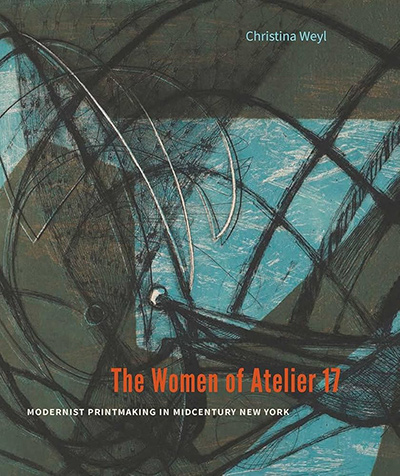 GAINESVILLE, FL – The only thing better than enjoying a progressive, local, independent bookstore co-owned by award-winning author Lauren Groff and her husband is the serendipity of finding there an art book highlighting Louise Nevelson, the then-unorthodox midcentury printmaker, honorary NAWA Vice President and longtime NAWA member.
Groff’s store, The Lynx, prides itself on carrying a wide array of general-interest books with an emphasis on books that are currently challenged or banned in Florida. A related banned-book distributing non-profit, The Lynx Watch, Inc., borrows from the term for a group of lynxes (a “watch”).
No surprise then that Groff and her booksellers would select The Women of Atelier 17 – Modernist Printmaking in Midcentury New York by independent scholar Christina Weyl (Yale University Press, 2019) to grace the shelves. If only Groff and Nevelson could have met.
At the outset of the book, literally the first sentence of the Introduction, we learn that Nevelson “ruffled more than a few feathers with her unorthodox and expressive methods of marking, inking, and printing her etchings and engravings,” wrote Weyl. Nevelson spent ten months at Atelier 17, the avant-garde printmaking workshop located in New York from 1940 to 1955, producing approximately 200 experimental impressions from 30 plates. She is credited with exceeding even the workshop’s progressive standards.
Nevelson gouged lines in the metal printing plates’ surfaces “using both the burin, the traditional tool of engraving, and a kitchen can opener; created textural passages from impressing lace and other distinctive fabrics into the tacky surface…The final plate surfaces, while richly patterned, were shockingly raw,” wrote Weyl.
But it was Nevelson’s unabashed approach to generously inking her plates leaving thick inks on the printing surface that drew ire from the establishment (read: male) printmakers, including Boris Margo. Weyl noted that Nevelson’s confident persona projected outwardly and propelled her to superstardom in the art world starting in the 1960s, writing, “Even at this early date, she already possessed the audacity to defy the norms of midcentury femininity by standing up to a male authority figure such as Margo.”
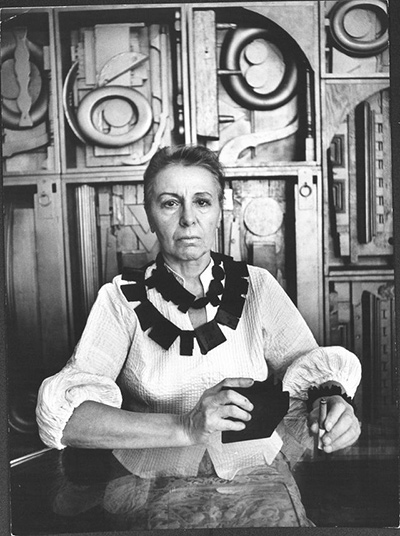
Photograph of Louise Nevelson, ca. 1965. Photo by Ugo Mulas. Louise Nevelson papers, circa 1903-1982, Archives of American Art, Smithsonian Institution
Nevelson is well known for her monumental wood sculptures, a discussion of which is beyond this book review. For more information about Nevelson, please read the NAWA Luminaries profile of Louis Nevelson by Susan Rostan by visiting this link. It is said that the Atelier 17 workshop was a useful bridge in her career, according to Weyl.
Weyl’s book positions Nevelson among a core group of eight women artists who used Atelier 17 workshop to develop the technical scale and aesthetic boldness to launch their careers. Although reportedly reluctant to join formal feminist movements, she did her part to transform Atelier 17 into an egalitarian laboratory, Weyl wrote.
Atelier 17 began in Paris in the late 1920s but relocated to New York during World War II. Nearly 100 women artists were affiliated with Atelier 17 during its time at three locations in Greenwich Village, New York, between 1940 and 1955. The author has posted an online biographical supplement to her book that explores each woman artist’s involvement with Atelier 17 and establishes little-known connections between them. The biographical supplement may be found at: https://www.atelier17.christinaweyl.com/
Nearly two-fifths of Atelier 17’s roster were women artists, but that era’s art critics and observers “consistently underrepresented and underrated women’s contributions to modernist printmaking in favor of European (male) expatriates and young (male) American artists who practiced at Atelier 17 in New York.” Weyl wrote that as the latter group ascended into the fame of Abstract Expressionism, including de Kooning, Motherwell, Rothko, and Pollock, the workshop’s founder downplayed their importance in favor of the Atelier’s best efforts by others. “Even with (the founder’s) comments, retrospective scholarship over the last 75 years has done little to raise awareness of women printmakers and their innovations.”
Welcome, Christina Weyl’s book. Thank you, Lauren Groff, for watching out for it.