ARTIST AT WORK
by Selene Paschoal
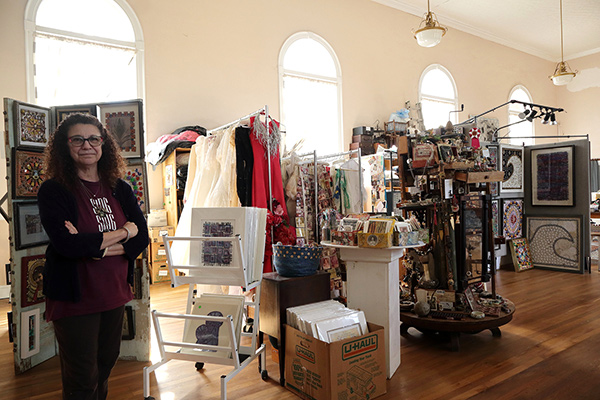
Susan Lens in her studio at the former Cateechee Mill Village’s church
Fiber and mixed-media artist Susan Lenz is known for her many transformations, the last one occurring in 2001, when she transformed from art framer to art creator. Lenz is known for transforming old fabrics and photographs, fibers, old toys, game pieces – even fax phones and circuit boards – into integral parts of her artistic mandalas. In July 2023, Lenz and her husband Steve took on the biggest transformation of all, turning a church into a studio for her and a home for them.
The Beginning
At age 8, Lenz had her first difficult experience with needles and embroidery. She was supposed to embroider a pre-printed piece as part of her Brownie Troup’s activity. She was told her work was not good because the back was messy. The following summer, Lenz’s maternal grandmother taught her the embroidery technique although the work remained challenging.
Despite her early brush with embroidery, Lenz believes those youthful experiences left an impression because years later, while walking through the Artist and Industry exhibition at the Ohio State Fair, she was inspired by the needlework to try again and shared her sentiments with her husband, Steve. Steve encouraged her to pursue needlework.
Lenz took his advice and repeatedly borrowed the Reader’s Digest Complete Guide to Needlework from the public library and completed all of the projects. The feeling of the floss in her hands and the thrill of seeing the work progress satisfied Lenz and fueled her skill development. A year later, she won a blue ribbon for her pillowcase project the state fair.
Turning Point
Shortly after the blue-ribbon award, Lenz attended an embroidery exhibit at a senior citizen center which, according to Lenz, was filled with the most incredible embroidery she had ever seen. It was a turning point in her career. She would either get serious about creating art or quit.
Through local contacts and her maternal grandmother, Susan met an embroidery artist who then introduced her to the Embroiderers’ Guild of America (“EGA”). EGA opened a new world to Lenz. During one of EGA’s meetings, Susan learned about the national EGA convention, which offered classes taught by world-famous embroidery artists.
Transformations Continue
Lenz relocated from Columbus, OH to Columbia, SC and ventured into antique dealing and framing of found antique pictures. To learn basic skills in framing, Lenz worked for 6 months in a frame shop that created pictures to be sold in the furniture industry. Orders started coming from other antique dealers and their friends.
Lenz was about to get a business partner at the frame shop – her husband. Pregnant with their second child, her husband quit his job and started working alongside her. The business, called Mouse House, grew to a sizeable framing shop in South Carolina, employing a staff of 14.
Due to the business, the couple could not vacation together. For her part, Lenz attended the National EGA conventions. She studied under several internationally acclaimed needlework artists, including Charlotte Miller, Jan Beaney and Jean Littlejohn. Back at home, most of Susan’s time was devoted to the framing business and family. She had a small window of time –between her children’s bedtime and 1 am to work on her needle art. One of the pieces she created in that period was a treasure box to hold family memories.
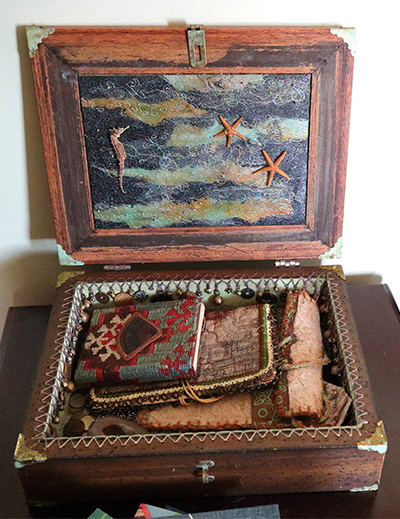
Susan’s treasure box
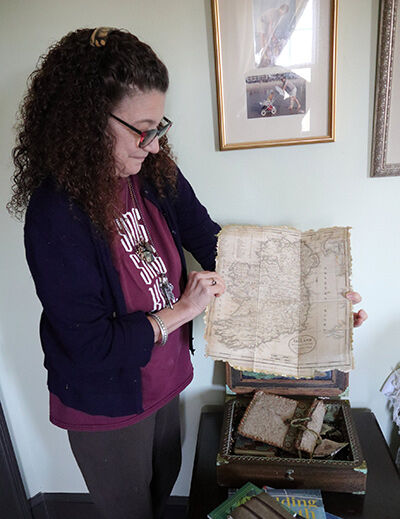
Susan & one of the many treasures in the box
In 2001, the couple decided to scale down the framing business so Lenz could embrace being a fulltime artist. She consulted her friend and mentor, artist Stephen Chesley, who advised she was already an artist and “just needed to do the work.”
400 Mandalas and Counting
Chesley advised Lenz to make a series of 100 related art pieces. He told her to explore every option while working on this series, but to ensure the last piece was as full of energy and spontaneity as the first one. Lenz has passed that 100-piece mark by many mandalas.
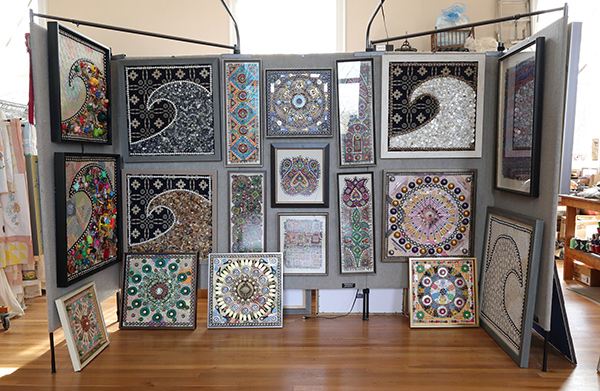
19 of the 400 plus mandalas Susan has created over the years
Lenz took Chesley’s advice to heart. She said, “People who approach their art from only looking at its potential for sales, limit their own experimentation, they limit their own creativity. I do things because I want to see what happens.”
Lenz’s studio showcases the variety of artworks she has created, including mandalas of all sizes and colors, wool bowls, needlepoint art, quilts, stained-glass, three-dimensional pieces, and items that are part of her installations.
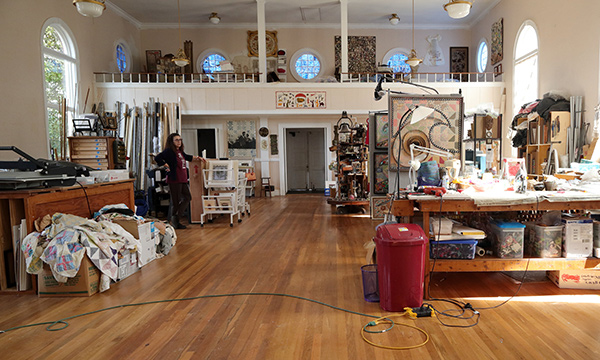
Susan Lens in her studio at the former Cateechee Mill Village’s church.
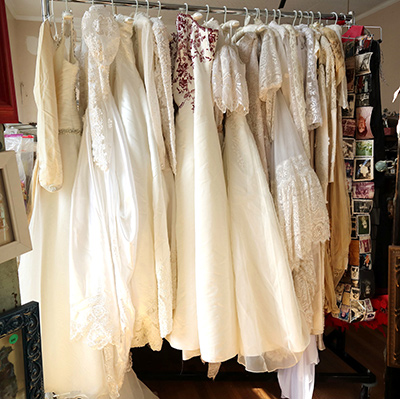
Dresses used to create The Big Day Solo Installation at the Pickens County Museum of Art and History, summer 2021.
Installations
Moving from only creating art pieces to installations felt natural for Lenz because of her framing store experience. “You can’t spend all these years discussing someone’s living room color and décor without thinking on a regular basis about the use of space,” she said.
By 2003, the couple had downsized the custom framing business, allowing her to work from a studio at Gallery80808/Vista Studios.
Her first installation, entitled “The Sacred Circle,” consisted of bowls, that Lenz calls “vessels,” made from soft, beautiful, colorful wool she found at yard sales and repurposed. She initially contemplated displaying the vessels on pedestals but rejected that idea as too presumptuous in favor of tree stumps.
While creating this installation, she relied on the “sacred circle” concept included in the book Cardinal Points. She arranged the bowls on top of the tree stumps marking the four points, thus creating the installation.
By her second installation, Lenz knew she could command the exhibition space and bring artwork into it that speaks to people and gives them an experience that is out of the ordinary.
Her enthusiasm for art and exploration is reflected in her telling of her lifelong experiences. In 2008, Lenz discovered art quilting during a six-week art residency at the Robert M. MacNamara Foundation on remote Westport Island in Maine. She credits Duncan Slade, the MacNamara Foundation studio manager, and Jeanne Williamson’s book The Uncommon Quilter for turning her attention to art quilting.
The Church Transformation
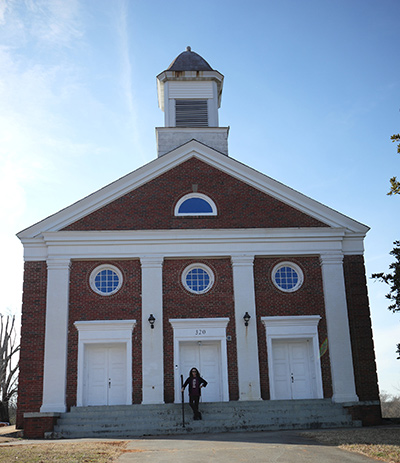
You would never guess what is inside by looking at the outside.
Lenz wanted to retire to a spacious warehouse where most of the space would be used as her studio and a small corner dedicated to living quarters. In December 2022, while looking for a suitable warehouse, Steve found the Old Cateechee Textile Mill Village Church, which was for sale. The church had not been used since 2018 and it needed quite a bit of work, including a new roof.
Six months later, the couple had the old church under contract and began the due diligence process, which involved expenditures on consultants, financing and closing documents.
Lenz said the process was a bit scary, but she had a vision and fell in love with the property at first sight. Many artists call their studio their sacred space and here she was, literally in a sanctuary where people were baptized, married, took first communion, and delivered eulogies.
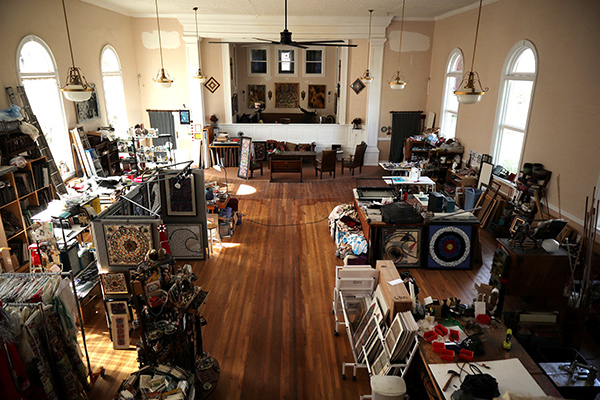
An amazing space full of artworks already completed as art pieces in progress and material to be used in the next one
The couple renovated the sanctuary and converted the church offices and nursery into living quarters. Nine months and almost $350,000 later, the Lenz couple moved into their new home and studio.
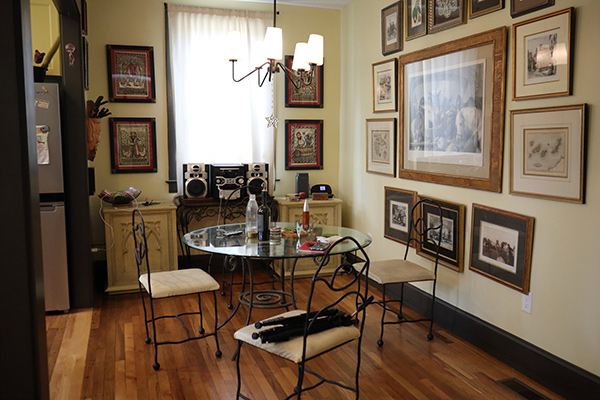
Artworks are everywhere, including in the living areas. A place full of treasures
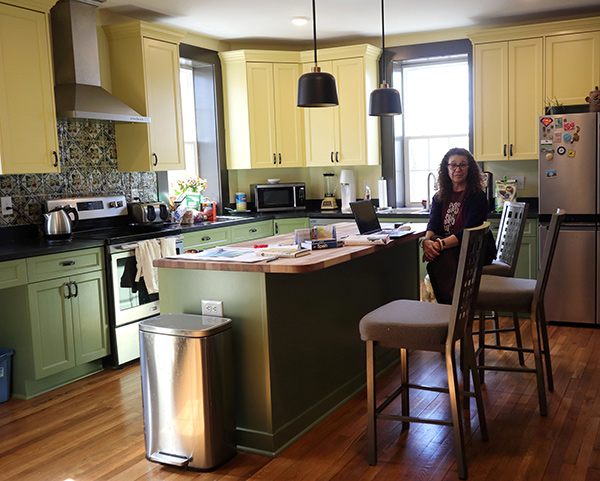
Looking at the kitchen, you would never guess it was once the office of the church.
The Church is located at 320 North Church Street, Central, SC 29630. The sanctuary-sized fiber arts studio is now open by appointment (803) 254-0842.
Lenz’s work has been featured in national publications, juried exhibitions, and fine craft shows, including the Philadelphia Museum of Art and Smithsonian Craft Shows. She has appeared on art quilting television programs and South Carolina ETV’s Palmetto Scene. Her pieces are included in the permanent collections of the Textile Museum and the Department of the Interior Museum in Washington, D.C., as well as the McKissick Museum in South Carolina. Lenz is represented by the Grovewood Gallery in Asheville, North Carolina. To learn more about Susan Lenz and her art, please visit http://www.susanlenz.com/default.shtml