ARTIST AT WORK
by Jen Haefeli
The International Day for Mine Awareness is observed on April 4th. The removal and disposal of fragments, munitions, and unexploded weaponry scattered throughout former battlefields regrowing into farmlands remains a challenge. Once this material has been processed, what becomes of it? As is often the case, creativity is the answer. Artisans are stepping up to the challenge. Piece by piece, the land is being cleared, and the now safe and clean raw materials are being sold in the form of adornment.
I recently had the fortune of meeting some of the team members of Article22, a sustainable enterprise working to reinvest its profits in growing its mission. The designers working with Article22 and their team partner with artisans who are taking this challenge on in an innovative way. Working with farmers-turned-artisans in the off-season, design teams offer creative refuge and a source of revenue. At the same time they meet the goal of utilizing as source materials the unexploded bombs and munitions that actively lie in wait within the fertile ground around farms. in countries like Laos these organizations, trained to safely remove these materials, work to clear the land. Companies like Article22 are utilizing bullets, casings, AK47 machine gun parts, and brass bombshells that are emerging from the Earth after no less than a half a century. These salvaged materials are now being turned into peace-promoting jewelry, wristbands, keepsakes, ornaments, and even custom wedding bands.
The U.S. bombing of Laos, ‘the secret war’ and ‘the forgotten war’, left Laos the most heavily bombed country in history. The United States and the former Soviet Union utilized Laos as their battleground, making this conflict of the Cold War one of the deadliest and most hidden. President Dwight D. Eisenhower’s theory was that a win would prevent ‘the Domino Theory’, stopping the spread of communism. As the war raged on, President John F. Kennedy opted to utilize a bombing campaign to prevent supply chain lines into Vietnam from being impacted. Laos was steadily bombed from 1964 through 1973.
Eventually, ’iron bombs’ ran low. The choice to use napalm was made. This sinister secondary destructive agent coated thick foliage throughout the Ho Chi Minh Trail, destroying all coverage. Those who survived within the former jungle atmosphere were left gravely ill and heavily scarred.
Facts of the ‘secret’ and ‘forgotten war’:
- Laos was bombed every 8 minutes, 24 hours per day, for 7 years.
- More bombs were dropped on Laos than on Germany and Japan throughout WWII.
- 50,000 Lao have been injured or killed by bombs dropped by the United States.
- 98% are civilians.
- 30% of the bombs dropped on Laos did not explode on impact.
- 20,000 people have been injured or killed since the bombing campaign ended in 1964.
- 40% of the injured are children.
- It is estimated that 80 million bombs remain in Laos.
- Laos is a thriving, foliage-rich country with plentiful natural resources.
- Agricultural land is useless with live munitions underneath the soil.
- These significant barriers cause stagnation in the Laotian economy, preventing growth.
- The United States is NOT among the 110 countries that have ratified a treaty banning cluster munitions.
Steps have been taken to safely remove shrapnel from the more than 270 million bombs and unexploded munitions remaining in Laos. The enormity of the debris has forced the need to utilize it. The unearthed munitions, bombs and plane parts have been utilized for structural assemblage of homes, placement within yards, architectural features, and household items, including bowls and spoons. The use of these materials has been done in an impressive and creative way, displaying that despite the history and harm to the country, Laos and her people hold many treasures, even among the ruins of war. Laos remains biologically diverse, with 47 ethnic groups amid the population. The country boasts a thriving culture of craft, of which metal work is merely scratching the surface. Weavers and dyers in Laos are highly skilled craftsmen.
For its part, as a primary contributor to the toxic and deadly environment the Lao live in, the U.S. government budgeted funds with the intention of using the money to help clean up the formerly war-torn region. However, the cleanup efforts that have taken place for the last 30 years have ended. According to a 2024 report by the Congressional Research Agency, the combined budget for Cambodia, Laos, and Vietnam’s foreign aid from the United States federal budget was 0.2%. The budgeted funds helped to clear land mines, to address contaminated land sprayed with Agent Orange by the United States (which remains), to promote economic development in the region, to prevent human trafficking, and to provide investments in education and medical services in communities addressing ongoing health concerns. All funding from the U.S. government has completely ended, although the commitment for the funding was not fulfilled. Simply put, the work is not done.
Many who have participated in military service feel a desire to assist with the effort. Some veterans feel that the decision to abandon the responsibility to remove debris is an abandonment of the promise the United States made to Laos. Committing to seeing it through is what the people at MAG do. The Mines Advisory Group, MAG, is a United Kingdom-based company challenged with removing debris in partnership with Laos’ military troops. They work to prevent explosions from happening. Founded by Rae and Lou McGrath, MAG shared the 1997 Nobel Peace Prize for their work in banning landmines. The procurement of the byproduct, shrapnel, provides an opportunity for MAG to step in. MAG staffers work in fields throughout Laos to de-mine and clear the land, recovering unexploded munitions and removing shrapnel to reduce the risk of injury or death to the population of communities they work in. MAG works in conflict zones to clear land, and help to make it possible for over 20 million people in 70 countries to have a future free of fear of the unknown under their soil. Once they clear the land, they clean the raw materials and source them to artisan groups, and organizations like Article22.
Article22 was co-founded by Designer Elizabeth Suda. Suda is a New York native who worked in merchandising with the leathergoods company, Coach, for two years before following a desire to find out more about production. Suda set off on a sustainable artisan quest for answers to what might seem like basic questions: ‘who’ made the goods that we consume, and ‘how’? She found a unique answer when she met artisans making spoons using melted bombs and munitions recovered from the farming communities they live in.
Suda also learned that the population of Laos has implemented the use of flare tubes, fighter jet and cluster bomb scraps, mortar and flare shrapnel, and a variety of non-war related scrap aluminum to create items for use. Seeing the material in its raw form, aluminum and iron, must have felt like an organic beginning, a foundation laid long before her arrival to the country. It must have been a kismet moment. Her merchandising hat went on. Suda could utilize her skillset, and the world would know about what happened in Laos.
As described on Article22’s website, these pieces are the “most abundant metals on earth…generated inside of collapsing stars.” Horrific and yet poetic, like stars, these pieces found themselves falling. The website further explains that these elements are also “found in our blood.” One can have an “iron will.” How mighty powerful it is to know that these elements have been weaponized for harm. Yet, there was Elizabeth. Suda knew that she could open new doors, elevating what she observed. So, she did just that.
Suda has an entrepreneurial mind. She understands the interconnectivity of marketing and selling one’s designs; however, she did not want to circumvent the artisans. Suda co-founded Article22 to raise awareness of the unfinished work in Laos, and as stated well on the site, she did so, “…to help buy back the bombs” and munitions from the communities impacted. It seems clear that Suda learned the “why,” the “how,” but also the “who.” The “who” has become more than Suda and the artisans in Laos. Article22 now partners with designers, offers home goods, and has collectors in 40 countries around the world.
Co-Founder Camille Hautefort has a strong international footprint with a developed career in investment banking and international finance. Camille’s global experience provides a strong foundation for developing Article22 within the U.S. and abroad.
Co-Founder Gael Forterre is an experienced hedge fund analyst who began his career in Paris. He has a keen eye for developing responsible growth within companies.
When communities need to be mended, it is a beautiful thing to learn the story of who steps in to help. Responsible, sustainable help. Laos is a case of a once naturally adorned landscape, lush and green, with a picturesque calmness. The unrelenting pelting of war may have ceased, but when accidentally revealed innocently by children digging for crabs, or by farmers harvesting their land, the hidden dangers resulted in intermittent explosions. The thin veil of overgrowth that attempts to reclaim Laos’ beauty hides pockets of deep destruction, threatening to bring carnage raging back to the surface. Every purchase from Article22 mitigates the danger. Each Article22 partner and designer is dedicated to eradicating the risk factors associated with war debris.
Legacies of War and Article22 is one example of a working partnership. Legacies of War is primarily comprised of war veterans who assist with the search and removal process, who often find that returning to Laos helps them heal some of the plaguing wounds of war. Legacies of War’s founder Channapha Khamvongsa’s parents taught her to give more than she receives. She is passing that on through the foundation, offering opportunities for education, art, cultural awareness, and community engagement. The Legacies of War Article22 collection furthers Channapha’s work through advocation of Laos, providing opportunities for healing, and of course, the removal of munitions from the land. Legacies of War advocates for the U.S. Government to increase funding for those impacted by past conflict.
Rebecca Rusch’s Be Good line of products is inspired by the loss of her father, Captain Rusch, an Air Force pilot whose plane was shot down near the Ho Chi Minh Trail. Rebecca cycled 1,200 miles to the site alongside a Vietnamese cyclist who also had lost a family member in the conflict. Rebecca founded The Be Good Foundation, which pays homage to her father’s final words to her: be good. The Blood Road, produced by Red Bull Media, chronicles Rebecca’s journey to her father, Captain Rusch’s, crash site.
In Your Body Is A Good Place To Be , from Beatrix Ost created for Article22, issues a challenge to others to recognize the beauty of their vitality. Rather than hiding it, Beatrix tattooed her forehead, emphasizing a scar. She has opted to radically embrace her new outward identity. Her work is bold, and beautiful, just like she is.
In Ukraine, artist Stanislav Drokin partners with Article22, creating custom, one-of-a-kind Pendants for the ‘Drokin’ Revival collection, utilizing brass, semi-precious stones and shards of shrapnel found near Kharkiv, his hometown in Ukraine. The Revival collection is intended to preserve the destruction of the war, and while it might promote feelings of grief, it is also intended to stand as a reminder not to give up. The collection is a physical example of progress, the preservation of information, and it is a marker of the tragedy of war’s destruction. He sees his work as a form of documentation, and explains when asked that his favorite piece will be made utilizing the last piece of shrapnel removed from his hometown, as it will symbolize that the war is over, and that the people of his country are safe again.
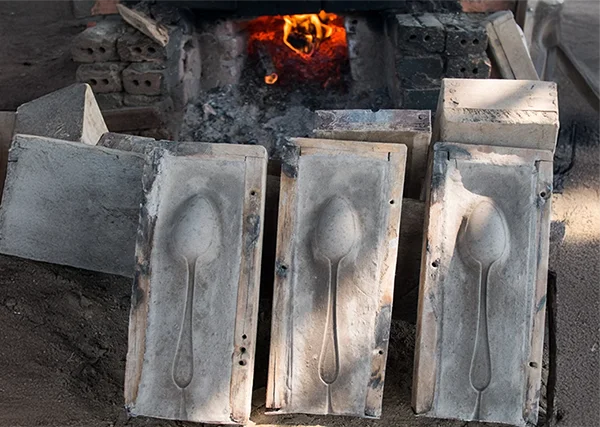
Each artisan follows a different process for how they work with reclaimed munitions, scrap metals, shells, and safely detonated explosives. Once they are found and removed by professional teams like MAG and Legacies of War, the pieces are cleaned, and in some cases, liquified and poured into wooden molds. No matter what they become, each of these incredible pieces has a unique feel. All are lightweight and hold a special rustic patina. From ornamental spoons to charms, bracelets, earrings, necklaces, rings, and decor, the scope of creativity for how materials extracted from the Earth are being utilized is impressive. Custom and fine pieces are available, too.
The name Article22 is derived from the Universal Declaration of Human Rights, or the UDHR, and is considered to be the establishment of individual rights, including but not limited to: Social Security, Dignity and Development, Core Rights Coverage, the right of Implementation, which grants reliance on international resources, and Cooperation. Additional tenets include the Freedom of Association, and the Respect of Privacy. (Source: Amnesty International)
The dedicated Article22 team has a diverse background offering an inspiring variety of ways they commit to fulfilling the mission. The families of XIENG KHOUANG, LAOS, have worked with Article22 since 2009. Several families returned to their farming community after the Vietnam War to find exploded and unexploded remnants of the battles that had taken place. Since partnering with Article22, those families have earned five times the local hourly wage, and their children can play safely on their land.
You can view a selection of items that I hand-picked on Article22.
Sources
https://winwithoutwar.org/secret-war-forgotten-war-the-u-s-bombing-of-laos/
https://www.clusterconvention.org/
https://www.history.com/articles/laos-most-bombed-country-vietnam-war
https://thewarhorse.org/vietnam-veterans-clean-up-bombs-laos/
https://www.bbc.com/audio/play/p0fjwcjy
https://article22.com/?srsltid=AfmBOoqXIf1j-6hgiHkGC26uVrRBZICSGHnfMvBTYjSUQJ1rBGIt9Yfq
https://news.un.org/en/story/2025/04/1161391#:~:text=The company’s name comes from the Universal,**Clear minefields now used to grow rice**
https://article22.com/blogs/transformation-story-project/gilesandkensingtonpalace
https://article22.com/collections/featured/products/spoon-charm
https://www.legaciesofwar.org/
https://www.legaciesofwar.org/post/the-beginnings-of-the-bombing-of-laos-1964#:~:text=Souvanna and other Lao Anti,infiltration and combat PL forces.
https://en.wikipedia.org/wiki/Operation_Barrel_Roll
https://winwithoutwar.org/
https://article22.com/pages/massiveattack
https://article22.com/products/copy-of-shard-pendant-2322-revival-stanislav-drokin-collab?variant=44537412878551https://article22.com/pages/about#:~:text=ARTISANS XIENG KHOUANG, LAOS,to play and grow rice.
https://www.legaciesofwar.org/
https://article22.com/pages/impact
https://article22.com/collections/necklaces/products/virtuous-circle-necklace
https://article22.com/pages/peacebomb-story
https://article22.com/blogs/transformation-story-project/gilesandkensingtonpalace
https://article22.com/pages/about#:~:text=ARTISANS XIENG KHOUANG, LAOS,to play and grow rice.
BLOG
https://article22.com/blogs/transformation-story-project/gilesandkensingtonpalace