BOOK REVIEWS
by Kathleen Warren
Several months ago, I read a comment about President Franklin Delano Roosevelt and his administration supporting the arts as a significant part of recovery efforts for the Great Depression. Thus, a seed of interest was planted, especially as I considered the relevance to today. From my photography background, I knew of the FSA photography division and especially the work of Dorothea Lange and her iconic image, “Migrant Mother.” When I saw this book, New Deal Art (World of Art), by John P. Murphy (Thames & Hudson, 2025), I decided it was time for me to dig a little deeper. A teaser comment on the back cover suggested that some of the questions and issues raised here are particularly relevant to our current society, and I certainly found that to be true.
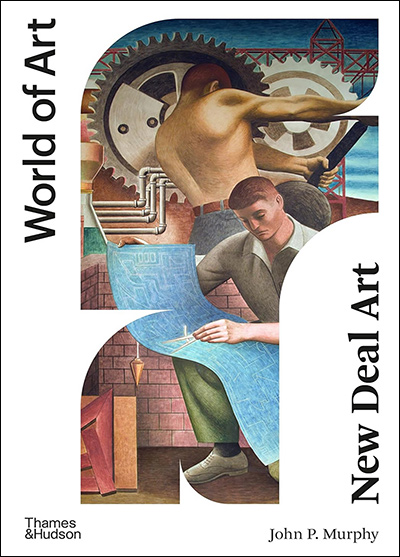
The book has more than 250 illustrations, very well placed next to the explanatory text. Also, I remember being confused about all the programs and acronyms of the New Deal, but this book has a glossary of acronyms and clearly explains those relevant to arts. The chapters are laid out in close to chronological order, and relevancy to today is discussed toward the end.
Introduction: Crisis and Opportunity
The 1930’s brought two crises—economic depression and the global rise of dictatorships. Along with New Deal legislation for economic recovery, Franklin and Eleanor Roosevelt felt that the arts would be part of the revival since there was a cultural crisis parallel to the nation’s economic crisis. FDR later said, “One hundred years from now, my administration will be remembered for its art, not its relief.” New Deal art had a vision of art as essential to democracy, yet the issues of censorship and inclusion of all voices in the country arose and remain pertinent today.
Ch. 1. The Public Works of Art Project
This program was temporary, lasting less than a year. The money came from existing funds until specific legislation could be approved. The program was somewhat needs-based with a justification of supporting artists through the winter of 1933-1934. Thousands of artists were hired to portray the “American scene”, but there were of course competing views of what exactly comprised the American scene. Which artists are chosen? How will they represent this? What is the role of the government in regulating the art?
Ch. 2. The Section of Fine Arts
With the support of Franklin and Eleanor Roosevelt, the Federal Art Project was created. The Section of Fine Arts came under Public Works and Construction costs, so its funding was stable. In a 1934 article for the Atlantic Monthly, Edward Bruce, new director of the Section, wrote, “Our objective should be to enrich the lives of all our people by making things of the spirit, the creation of beauty, part of their daily experience; by giving them new hopes and sources of interest to fill their leisure; by eradicating the ugliness of their surroundings; by building with a sense of beauty as well as mere utility; by fostering all the simple pleasures of life which are not important in terms of dollars spent but are immensely important in terms of a higher standard of living.” Yet again, the issue of inclusivity and censorship arose since the artworks, mostly murals, were limited to positive themes.
Ch. 3. The Federal Art Project
The Federal Art Project (FAP) was more decentralized than the Section, employing more than 10,000 artists; however, it was needs-based like the Public Works of Art from Chapter 1. FAP funding relied on annual appropriations from Congress; therefore, it also relied on continual justification. With the FAP, there came a change in the role of the artist who now was seen as a worker and their art as a public service. The director was Holger Cahill, who played a significant role in New Deal art programs. One goal was to not only create art but to maintain and even improve the skills of the artists, reasoning that if they took jobs elsewhere they would lose art skills and perhaps quit making art altogether. There were different divisions such as murals, easel paintings, and sculpture. To sum up the counterintuitive nature of arts funding under the New Deal, one author stated that the Great Depression “may prove to have been the best thing that ever happened to American art.”
Ch. 4. The FAP Graphic Arts and Poster Divisions
The Graphic Arts and Poster divisions of the FAP produced prints with the goal of breaking down the walls between the public and the arts. There were approximately 800 artists in more than 35 cities. These divisions had less oversight, thus less censorship, than other divisions. The Poster division created posters for public areas that promoted health, safety, travel tourism, and cultural education programs.
Ch. 5. Farm Security Administration Photography
Personally, I was more familiar with the FSA photography program. The classic icon of the Great Depression has come to be a photograph, “Migrant Mother,” by Dorothea Lange. Overall, the FSA photography program was part of a huge public relations campaign and served to humanize the effects of the Great Depression and to encourage the government to take action. Over a span of eight years, an estimated 175,000 negatives were produced, often referred to as the greatest photography collection in the world. These photographers, including such eminent artists as Lange and Gordon Parks, put a face on the hardships and sought to move the public beyond narrow self-interest. They invited viewers into politics based on imaginative sympathy and emotional appeal. The FSA photography program was funded through the Farm Security Administration so funding was more stable and continued into World War II.
Ch. 6. The FAP Index of American Design and Community Art Centers
The FAP Index was created to be a visual encyclopedia of American folk art, but like other programs, there was the issue of what constituted “American design.” The Index was part of a broader government effort to preserve folk cultures, and it included architecture, music, and crafts. The Community Arts Centers also were created during this time. There were more than 100 centers in the nation, and the Walker Art Center in Minneapolis is still running today. The Centers presented art as a process rather than a product, including art education, vocational training, studio space, lectures, performances, and exhibition opportunities.
Ch.7. The Artists Union
Roots of the Artists Union go back to the beginning of the Great Depression and perhaps earlier. The John Reed Club formed in 1929 with a loose association to the Communist Party of the USA, and many artists joined. In 1933, a group of unemployed artists formed the foundation for the Artists Union. The Artists Union became the main bargaining unit with the FAP, but it was only possible to bargain because the artists had a common employer, the US Government. The Artists Union focused on cuts to federal funding for the arts, but civil rights for women and persons of color were also addressed. In late 1934, the journal Art Front was started and became a leading venue for debates over art and politics. Murphy wrote, “the fragility of art program funding combined with regressive new policies convinced artists to open a bold new front.”
Ch. 8. For a Permanent Federal Art Project
In almost every issue, Art Front called for the continuation of federal funding of the arts. In 1935, the journal stated, “The Artists Union holds that the artist is a vital part of the life and culture of his community. There are public buildings to be decorated; there are children eager to be taught; there are libraries, schools, and hospitals that want pictures of all sorts for their walls; there is a need for new books with illustrations for schools. These and many more needs of the community can be filled by the artists.” So-called “anti-New Dealers” opposed arts funding and succeeded in defeating a Congressional bill to establish an ongoing Bureau of Fine Arts. In 1939, the Reorganization Act disrupted the existing arts funding programs and created conditions that led to the ultimate demise of FAP and related arts programs.
Ch. 9. Artists Against War and Fascism
Artists were involved in the US response to the rise of fascism and dictatorships in the 1930s. In 1935, the American Artists Congress Against War and Fascism was formed, and in a 1936 convention, artists discussed the German Nazi policies of calling all modern art “degenerate” and purging art museums of so-called “non-Aryan” art. Because the US remained officially neutral at the start of the global conflict, artists on the federal payroll had to proceed with caution. As a result, they emphasized the suffering of victims rather than the crimes of perpetrators. As the US moved closer to war, artists shifted from art against fascism and war toward art supporting war against fascism.
Ch. 10. Artists for Victory
During the 1930s, the US was not eager to enter another war while the losses from WWI were fresh in the public’s mind. As FDR was becoming a war president rather than a New Deal president, his public remarks signaled an end to federal arts funding. Artists and art remained as part of the war effort until FDR ordered that all art programs wind down in 1943. Holger Cahill, instrumental in the success of New Deal art programs, said, “The power that will draw the people together in the end will not be the power of bayonets or high explosives. It will be this conception of the unity and attraction of culture.” Murphy wrote, “Yet after ten years the ‘new horizons’ for American art that Cahill imagined turned out to be a mirage.” We have not seen the US government invest in art at the level or anything near the level of funding during the New Deal.
Conclusion: The New New Deal
What happened to the artworks from the New Deal? No agency took responsibility for conserving this art, photography being a notable exception, so much was destroyed or auctioned off for pennies. Virtually none of the posters remain, few of the easel paintings or sculptures survived in public collections, and many murals were painted or plastered over. As McCarthyism rose, socially conscious artwork became very risky. Art seemed to fall into disrepute, both for political and aesthetic reasons. One of the visions of New Deal art funding had been to preserve the skills of artists, and in many respects this goal was realized. Some of the artists supported by New Deal funding dismissed the art they had created, but they did not dismiss the programs themselves. Artists Union president Boris Gorelik said, “There was ferment; there was curiosity; there was agitation; there was activity; there was interest; and there was freedom of thought.”
Wrote Murphy, “This expansive, multicultural vision of American art remains one of New Deal art’s enduring aspirations, however faltering or unrealized.”
We live in a country shaped by the New Deal, which shifted the role of the federal government in everyday life, yet this shift only partly extended to culture. Without a Ministry or Department of Culture like other developed nations, US funding for the arts turns on the political climate and relies heavily on private support. The author concludes that the legacy of the New Deal programs lies not in rare masterpieces but rather in an ongoing effort to reimagine the relationship between art and society. With this history and the questions raised, a Living New Deal organization has emerged to continue the dialog.
One of the dominant questions that arose out of the New Deal was to what extent art has a role in a democracy. I would add – What role do the arts play in times of economic instability? What role do the arts play in our highly politically and culturally divided society? These are the questions that drew me to this book, and questions I feel should be discussed among artists and the public. I barely mentioned the underlying questions about gender and ethnic inclusion that arose with federal funding of the arts, yet those issues still confront us daily, as does the issue of censorship. Thus, I see the legacy of New Deal art as not so much the art itself but the questions that arose then and remain unresolved. As the jacket summary of the book aptly states, “New Deal Art confronts issues relevant to today: freedom and censorship, race and representation, art and activism, politics and propaganda. In an era of dwindling public arts funding, the New Deal’s vision of broadening access to art and culture remains as urgent as ever.”
For me, the book was a more complex read than I first realized, yet I found it to be well worth the time invested. Not only did I start to finally figure out some of those New Deal acronyms, I saw the actual 1930’s art and followed the story of arts funding in the 1930’s. I also found myself thinking more deeply about our 21st century environment and the role of art, my art included, in this society. What if public funding began to prioritize the arts? What if artists and their art could stimulate public thought about the role of the government? What if our art could be part of the answer to bringing people together?