NEWS + MEMBER EXHIBITS
by Patrice Boyes
Best known as the biographer of Lee Krasner, Judy Chicago and Edward (& Jo) Hopper, Gail Levin has authored the first scholarly biography of abstract expressionist and color field painter Alice Baber. The February 3, 2026, release of Alice Baber: An Artist’s Triumph Over Tragedy (Pegasus Books, 2026) coincides with a major selling exhibition of Baber’s work at the Phillips New York (March 5 to 26, 2026). (Ed. Note: See, related Book Review by Roz Dimon in this issue).
Levin also appeared for a book-signing at the NAWA booth at the recent College Art Association Conference in Chicago.
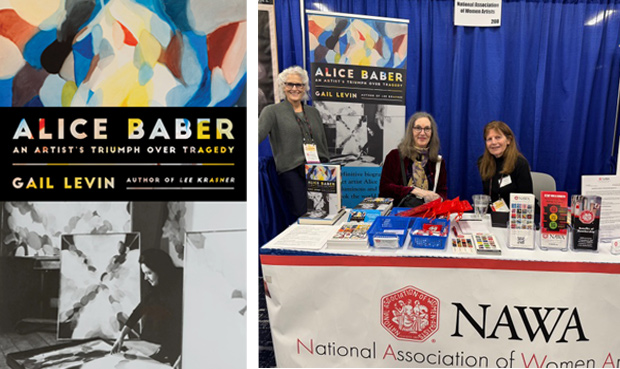
(L to R) NAWA’s Jill Baratta, author Gail Levin and NAWA’s Susan Rostan at Chicago conference
Levin, a NAWA Honorary Vice President, reveals Baber’s fascinating story, despite “concerted efforts to consign her to oblivion,” according to Levin’s publicist. Baber’s paintings had already entered the permanent collections of the Museum of Modern Art, the Metropolitan, the Guggenheim, and the Whitney at the time of her premature death at age 54. Levin’s book journeys through Baber’s rural upbringing as childhood prodigy to her years exhibiting globally in the mid-century art world.

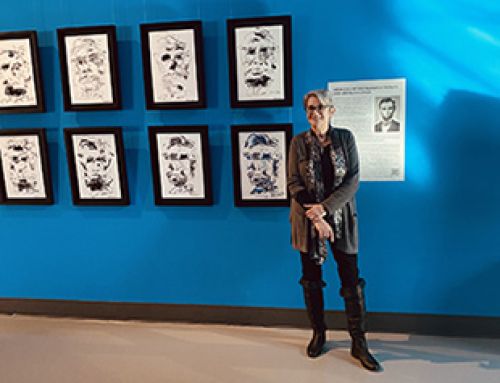
Author and NAWA Honorary VP Gail Levin. Photo credit: Timothy Greenfield Sanders
According to Levin, Baber took a step beyond the abstract expressionists with whom she sometimes exhibited. “Baber’s mature paintings are very controlled, not random—a characteristic that is often associated with abstract expressionism,” wrote Levin. She was a synesthetic artist who often linked color to both movement and sound, according to Levin, who added that from Van Gogh to Kandinsky to Joan Mitchell (Baber’s friend and contemporary), many famous artists have had this variant of normal perception. Scientists now link this normal condition to anxiety, wrote Levin.
Baber’s work is represented in at least 49 museums around the world, but her work has been forgotten until being rediscovered by collectors in the marketplace. According to Levin, Baber was childless and divorced and gave away most of her art and her savings at death, so there was no estate to market her work.
Levin observes that Baber was a feminist whose work relates to the feminist art movement of the 1960s and 1970s; however, her activist messages are sometimes rather subtle, even hidden. She experienced being considered an appendage of her artist husband, Paul Jenkins. She also experienced sexism in various artists’ hangouts in New York City. “In many ways, the story of Alice Baber is paradigmatic or a great example of the sexist treatment of women in the art world,” wrote Levin.