FEATURES – On Your Radar
By Micheline Klagsbrun
The Grey Art Museum, NYU
April 1–July 19, 2025
The Kreeger Museum
October 16-December 31, 2025
“Anonymous Was a Woman: The First 25 Years” celebrates recipients of the Anonymous Was a Woman (AWAW) grant program for mid-career women artists living and working in the United States. This groundbreaking program, inspired by a line from Virginia Woolf’s essay, A Room of One’s Own, was established in 1996 in response to the National Endowment for the Arts’ decision to end funding for individual artists.
Founded by visionary philanthropist and photographer Susan Unterberg, this program has provided annual unrestricted gifts of $25,000 each to ten exceptional artists over the age of 40, enabling them to further push boundaries in their creative fields. In 2024, the number of annual awardees permanently increased to fifteen and the cash prize doubled to $50,000.
“Since I am an artist, I knew firsthand that the needs of mid-career artists were generally overlooked,” said Unterberg, who herself remained anonymous until 2018.
Featuring 50 artworks by 41 of the 251 award recipients from 1996 through 2020, the Grey Art Gallery exhibition showcased a range of media and subjects by artists including Jeanne Silverthorne (AWAW 1996), Laura Aguilar (AWAW 2000), Senga Nengudi (AWAW 2005), Mary Heilmann (AWAW 2006), An-My Lê (AWAW 2006), Carrie Mae Weems (AWAW 2007), Ida Applebroog (AWAW 2009), Jungjin Lee (2011), Janine Antoni (AWAW 2014), and Jennifer Wen Ma (AWAW 2019), among others.
“Nancy and I sought to create a visually compelling and intellectually stimulating exhibition that balances work by well-established and lesser-known artists. We also wanted to highlight leaps in production that the grant made possible, both practically—many artists were enabled to try new materials and processes—and conceptually,” said Vesela Sretenović, co-curator.
The works range widely in use of media, tracing the development of contemporary art practice, particularly towards installation and time-based media. Some themes remain constant: the position of women in society, the shifting value of craft, issues of identity and community and the many uses of anonymity.
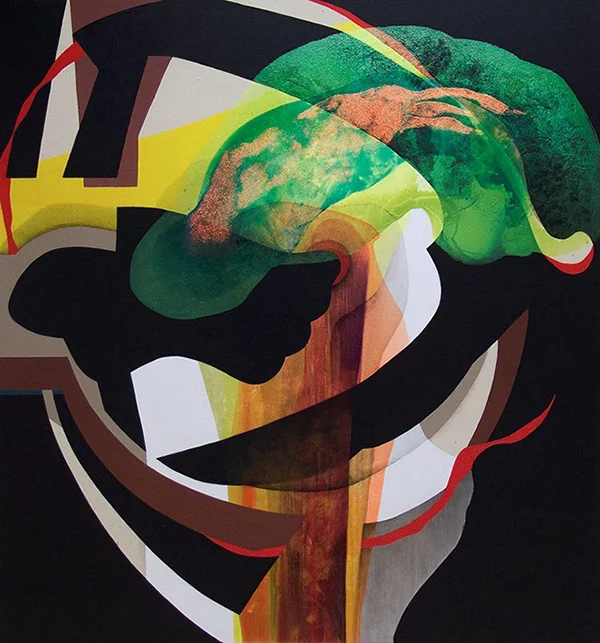
Carrie Moyer (AWAW 2009) Flamethrower, 2009, acrylic painting.
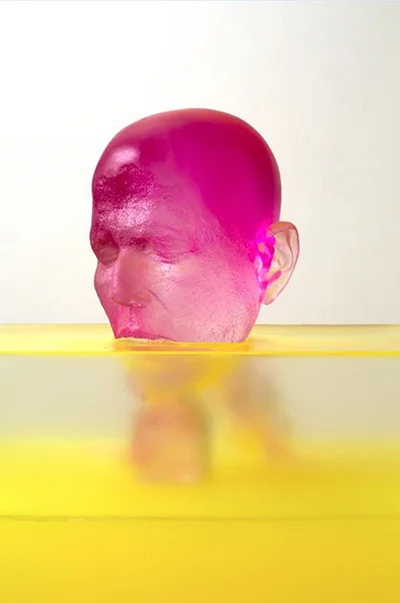
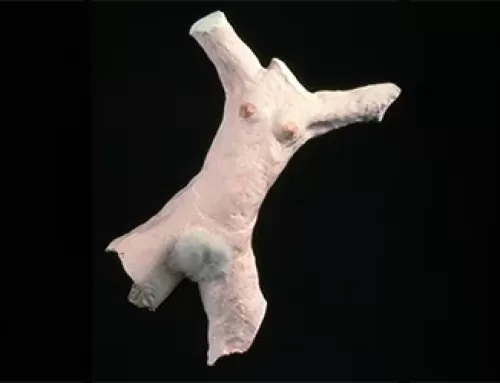
Rona Pondick (AWAW 2016) Magenta Swimming in Yellow, 2015, molded resin.
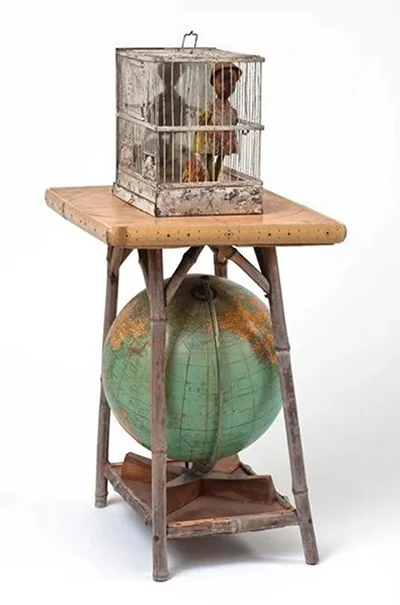
Betye Saar (AWAW 2004), Globe Trotter, 2007. Mixed-media assemblage. © Betye Saar. Courtesy the artist and Roberts Projects, Los Angeles.
“Flamethrower,” for example, a painting by Carrie Moyer (AWAW 2009), demonstrates the artist’s characteristic high-gloss surfaces and curvaceous, colorful forms, and challenges gendered conventions of abstraction. Rona Pondick (AWAW 2016), also featured in the exhibition, has used her own body to create self-portraits in various materials—such as the colored molded resin of “Magenta Swimming in Yellow”—that are at once deeply personal and anonymizing. Betye Saar’s (AWAW 2004) assemblage, “Globe Trotter”, depicts a worn vintage doll held captive inside of a small birdcage resting atop a globe—a combination of powerful symbols referencing the history of slavery and the position of women.
There is another chance to see the work of four more AWAW artists at the Kreeger Museum in Washington DC, where “Anonymous Was a Woman: Jae Ko | linn meyers | Joyce J. Scott | Renée Stout” opens on October 16, 2025.
The Kreeger Museum’s exhibition, also curated by Sretenović, focuses exclusively on four AWAW recipients who reside and work in the Washington, DC metropolitan area. Jae Ko (Korean American, b. Pyeongtaek-si, Korea) lives and works in Alexandria, VA and Piney Point, MD. linn meyers (American, b. Washington, DC) lives and works in Washington, DC, New York, NY, and Los Angeles, CA. Joyce J. Scott (American, b. Baltimore, MD) lives and works in Baltimore, MD and Renée Stout (American, b. Junction City, KS) lives and works in Washington, DC.
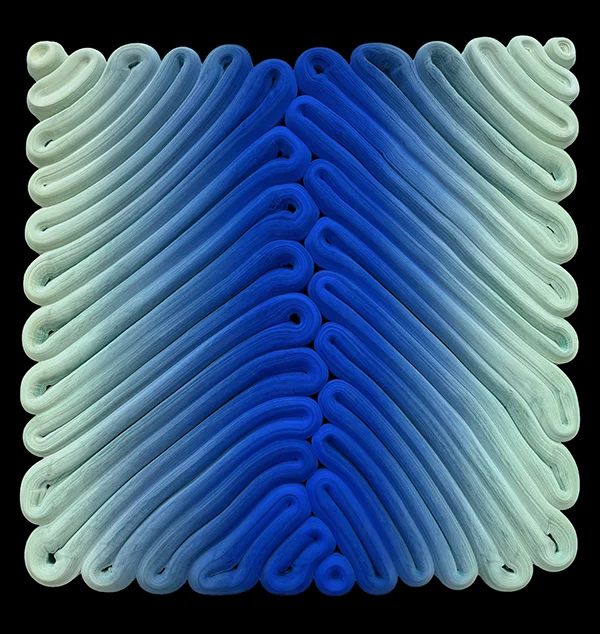
Jae Ko, Rhombus #3, 2025, rolled paper, pigmented ink. Courtesy of the Artist and Opera Gallery Paris.
“I love working with paper because of the challenge in using such a common, ordinary, everyday medium to create uncommon forms—and with it, new visual and sensual experiences. I cannot work against this natural tendency; rather, I join in and work together with it,“ said Jae Ko. Ko’s art is characterized by the simplicity and elegance of forms that draw inspiration from the natural world. The shapes of tree roots, branches and seagrass are transformed into refined three-dimensional abstract configurations and large-scale spatial installations. Composed of rerolled paper tightened diagonally within a rectangular frame, the compositions of her “Rhombus” series appear dense. Yet, through a carefully chosen palette of soft tones, they become weightless, almost airy, evoking impressions of changing skies, rolling hills and vast grasslands.
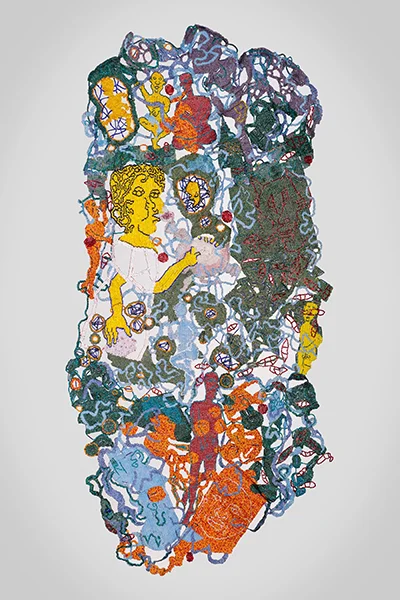
Joyce J. Scott, Untitled Fairy Tale from The Graphic Novel Series, 2019-2020, glass beads, thread, wire. Courtesy of Goya Contemporary Gallery/Artist.
“While I don’t have the ability to end violence, racism, and sexism, my art can encourage people to look and think… Power of art as a wearable spirit is unsurmountable… the power is to make yourself accessible to others,” said Joyce J. Scott. Scott is a weaver, sculptor, printmaker, performance artist, and educator. Her work directly confronts issues of racism, sexism, domestic violence, injustice, and ecological crisis. Yet, the artist addresses these themes with exceptional craftsmanship, grace, and humor. Scott’s intricate sculptural pieces are characterized by off-loop glass bead weaving that at times incorporates blown glass and found objects. Utilizing the “peyote stitch,” a technique in which shimmering beads are woven together in an improvisational, freeform manner, she invents as she crafts, allowing each piece to emerge organically. The resulting works are visually rich, seductive, and eye-catching. Yet, beneath their glittering surfaces lies a sharper reality: a pointed commentary on social ills subtly embedded within the ornate beauty.
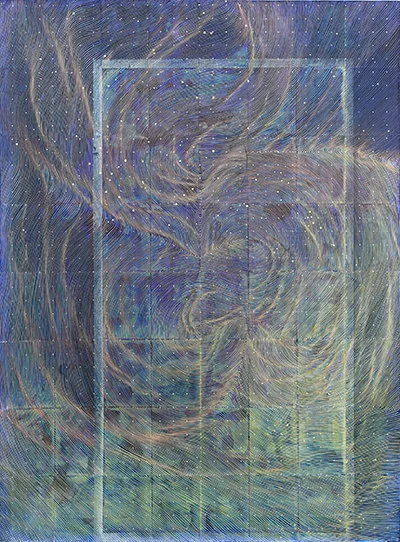
linn meyers, The Moon is a Thief, 2025, acrylic ink and acrylic gouache on linen. Courtesy of the Artist
“The moon steals the sun’s life-affirming light and transforms it, revealing beauty we might not otherwise see—to me, that is very similar to the work that artists are doing,” said linn meyers. Meyers is best known for her intricate paintings, drawings, and wall installations that explore infinite possibilities of mark-making. Made up of meticulously hand-drawn lines and dots, meyers’ works generate mesmerizing yet ambiguous visual arrangements, suggestive of topographical maps, cosmological charts, and psychological landscapes. meyers’ most recent paintings on display here–‘The Moon is a Thief’ and ‘Law of the Meander’—speak of precarious conditions of human existence. As the artist explains, the title ‘The Moon is a Thief’ is a slight modification of a quote from Shakespeare: “The moon’s an arrant thief, and her pale fire she snatches from the sun” (Timon of Athens).
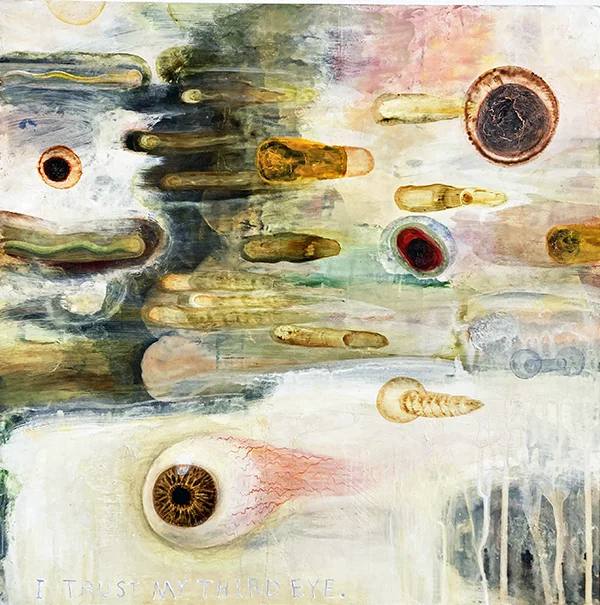
Renée Stout, I Trust My Third Eye, 2025, acrylic on panel. Courtesy of Marc Straus Gallery/Artist.
“When I make art, I have a need to process my life’s experiences in a way that makes them tangible…. Being a ‘mischif’ maker is being a necessary troublemaker,” said Renee Stout. Stout creates complex mixed-media assemblages and installations that reference ancient African traditions and symbolism, as well as contemporary socio-political events and everyday life in her Washington, DC neighborhood. A visual storyteller at heart, her work is rooted in the vernacular but infused with magic and fantasy. Fascinated by fortune tellers and the healing power of Voodoo priests—traditions that trace their lineage from Africa through American slavery to the present—she creates art, particularly sculptural pieces, that often possess talismanic qualities. In the Kreeger project, Mischif Maker, Stout presents paintings—”I Trust My Third Eye”, ’’Come Back Gil (Scott Heron #2)”, and “Mischif Maker”—along with sculptures—”Healing Stuff,” “Harriet Tubman’s Divining Rod,” and “The Guardian”—which appear as sacred relics or objects of reverence. They are imbued with empowerment, resistance, and spiritual significance.
While the Grey Art Museum exhibition featured works created around the time of each artist’s award, the Kreeger Museum’s presentation spotlights the most recent work of its participating artists, picking up where the Grey show left off in 2020. Whereas the Grey offered a broader overview of artistic production by women artists in the first 25 years of the award, the Kreeger show aims to present a more focused, in-depth look at the new works of Ko, meyers, Scott, and Stout.
In this respect, the Kreeger exhibition not only celebrates artists based in the DMV area —aligning with the Museum’s mission—but also extends the reach of the AWAW program beyond New York City, further disseminating its mission: to support and bring greater visibility to the creative output of women artists.
For those who cannot visit these exhibitions in person, I highly recommend the catalogue, which represents all 251 artists, including such prestigious names as Cecilia Vicuna, Lorraine O’Grady, Laura Poitras, Mickalene Thomas, Nicole Eisenman, Simone Leigh, Amy Sherald and Howardena Pindell.
“I think what is astonishing for all of us,” said Lynn Gumpert, director of the Grey Art Museum since 1997, “is to look over this list of amazing artists and realize the impact they have made on the last 25 years of the art scene. As of 2019—when we were first conceiving the show—just 11% of all acquisitions and 14% of exhibitions at major American museums over the past decade were of work by female artists, according to the Burns Halperin Report. We know that there is still a lot of work to be done.”