by Susan M. Rostan, MFA, EdD
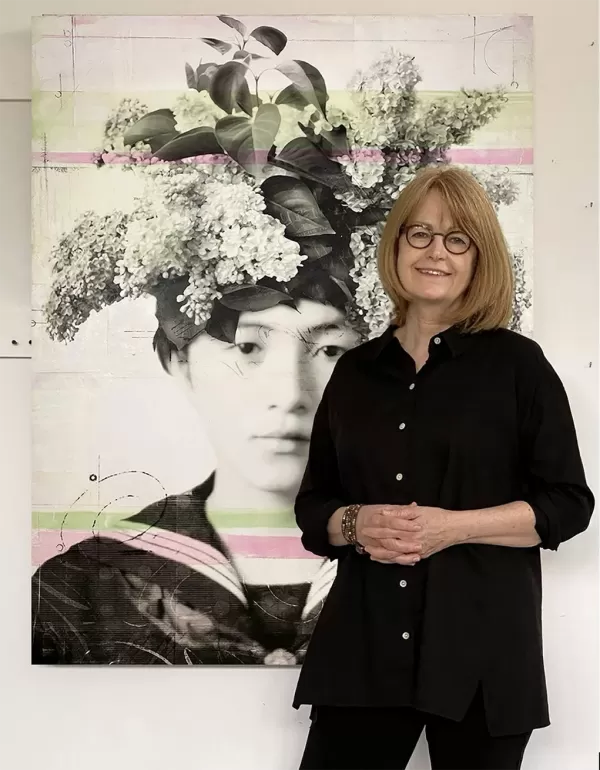
Marybeth Rothman was the guest speaker at NAWA’s annual luncheon on June 12, 2025, and, more recently, was invited to serve as a NAWA Honorary Vice President. [Editor’s Note: Her art is featured on the cover of this issue of NOW].
Rothman is a contemporary American artist known for her reclaimed and reimagined, fictional, visual biographies and abstract narratives. Her portraits were featured in “Modigliani and the Modern Portrait” at the Nassau County Museum of Art, and she was a semifinalist in the 2022 Outwin Boochever Portrait Competition at the Smithsonian Institution National Portrait Gallery.
She has exhibited in the Heckscher Museum of Art, Delaware Contemporary Museum, New Jersey State Museum, Bristol Art Museum, Cape Cod Museum of Art, Edward Hopper House Museum, Attleboro Arts Museum, and galleries throughout the US. Her most recent solo exhibition, “Recent Observations and Conjectures Near Madaket Road,” was on view at the Frederick Holmes and Company Gallery of Modern and Contemporary Art in Seattle, WA.
I had a delightful Zoom interview with Rothman at summer’s end. The discussion centered on her artistic journey, beginning with her early influences and experiences that shaped her artistic identity. The interview has been edited for clarity.
SMR: A lot of my academic research involves young artists and young art students’ skills. I’d like to know a little bit about your upbringing, specifically the role art may or may not have played in your life during your childhood. You grew up in Massachusetts, right?
MR: Yes, in southeastern Massachusetts in Taunton, near Cape Cod and east of Providence, RI.
When I think back, my first memory is not of my mother or my father. I had a great childhood with wonderful parents, but my first memory was of making something. This was nursery school or kindergarten. It must have been Columbus Day, because why would we be doing a boat? They gave us a blue piece of paper and parts of a boat: the brown part for the bottom, the hull, and then the mast. We were to glue that down and then glue on the sails.
SMR: And it was like magic?
MR: It was just like that. What just happened? I glued things down, and it’s this image. And also, oh, it must have been nursery school, because also from that time, they had clay that we could use. It wasn’t Play-Doh. It must have been real clay; it was in a big white container, and it was wet inside. The teacher would scoop out clay for us to use. And then it went on in elementary school. I would go through my math as fast as I could because it was the only time we used unlined paper in the classroom. I could go up and get some more and start drawing with my arm hiding it, so that the nun wouldn’t see.
At that time, most of our art projects were something that they did that we had to copy. I was happy to do anything, but I never really liked that. My mom was always good about making sure I was enrolled in an extracurricular class — like local artists teaching kids in their basements, but nothing formal. Another early memory of drawing was at a local pool club we belonged to. A woman came in to teach art, and we learned how to use pastels. And I can see, in my visual memory, my legs. I was in my bathing suit, drawing, and had pastels all over my thighs.
I was always drawing or making things, all the time. It was just my life. If my grandparents were going on a plane, I would make them a box, fill it with cookies I had made or candy, and decorate it.
I attended Catholic school, and art was at the bottom of their list of priorities. I was taking neighborhood painting classes, where the teacher would say, “Here’s a Hallmark card. Let’s reproduce this.” Nothing was ever from life.
I wanted to go to art school. And my mother, of course, was in favor. My father wanted me to attend Notre Dame and then return to work in his business. He had an insurance agency. And I was like, Dad, you know, haven’t you been watching? Then he understood. But he said, “You have to go to a really good school or I’m not paying for it.” It was a lot of pressure. Fortunately, I got into RISD and Pratt, and a bunch of other good places. It worked out.
I chose to attend RISD, the Rhode Island School of Design, and it was mind-boggling. I kept thinking they were gonna knock on the door and say, “Oh, we made a mistake.” It was ridiculous. Why would I do that? And it was great. I loved it. I loved every minute of it, and I just kept working and working. When I went to my first figure drawing class, I was like, “This is amazing. Why haven’t I been doing this?”
When I was a freshman, during Thanksgiving, my dear lifelong friend, who lived next door to me in the dorm, said, “Come to New York and we’ll go to museums.” We did, all weekend, and when I came home, I said to my parents, “I’m moving to New York when I get out of school,” and they’re like, “From one trip?” I’m like, “Yep.”
My friends from high school asked, ‘When do you party?’ I said, ‘We don’t party. We just work.’ Maybe at midnight on Saturday, you’d go out for a beer, but we just, just always worked. I guess I’ve always been an art nerd, but I had to have a practical major because that was part of my financial deal with my father. I could not be a painter, a potter, or a sculptor. So I was an illustrator.
When I graduated from school, I moved to New York and supported myself by working in a magazine’s art department, doing paste-up. No one under our age will understand that paste-up was a human Photoshop. I pasted the copy down and the photos, and drew any lines that needed to be added. I also worked as an illustrator, and I did well, eventually, supporting myself that way. And then I got sick of it. I thought, “Could you put a few more dots on the shirt?”
By the way, it’s always been the figure. Since day one, it’s always been the figure.
SMR: Who were your biggest artistic influences?
MR: The most influential was the startling show of Seurat’s charcoal drawings at the Met. It blew me away. Then there was Kiki Smith for her storytelling and Cy Twombly for his carefree, magical mark-making. Of course, Robert Rauschenberg, the bold trailblazer in mixed media, and Modigliani, for his very sensitive and beautiful, yet mysterious, portraiture. And I would say Matisse.
SMR: When did they enter into your artistic thinking? Was that in school or after college?
MR: Not until college.
SMR: Did you have any direct mentorship at that time or afterward? In school or afterward? Was there somebody that you considered a mentor to you that took you under their wing? .
MR: Yes, Lester Abrams. As an illustration major, he designed the characters for The Hobbit. All the people in that illustration department did something. We had to choose someone to work on our senior project with, and I approached Chris Van Allsburg, a Caldecott Award winner for his children’s books. And he said, “Well, I’ll work with you, but you can only do black and white.” I replied, “What?” So I said, “No, I have to work in color.”
Lester Abrams was more of a soulmate to me. We both worked in color. He was a genius. He was incredible.
SMR: You’ve given me a sense of the nature of the work that you were doing right out of college. So how did your work change over time?
MR: Well, as I said, I couldn’t bear being an illustrator anymore, having someone, me, bringing their vision to life. It was nice to see my things in print. However, I then got married and had children. When my second son was diagnosed with autism, I definitely couldn’t work anymore.
Then I started attending figure drawing classes, open sessions, and just sat there drawing, painting, and drawing some more. I started entering shows and got into galleries and museums, and then I discovered encaustics.
SMR: I’d like you to discuss your favorite subject and medium.
Could you provide a brief description?
MR: My inspiration has always been people and their stories. I would paint the figure, and I would either have models come to my studio or go somewhere where I knew there was a model. And then I started cutting up my paintings, which didn’t make sense. They were opaque, and I collaged them, canvas on canvas, using oil, not acrylic. At the same time, I also began experimenting with encaustic, a medium composed of pigmented beeswax. And simultaneously, it was like a big moment. I inherited a box of vintage photographs of family members when my father passed away.
I hung them along the perimeter of my studio because they were so beautiful. They were from the 40s, and the way people posed. I was very intrigued by these people, and I knew they were related to me, but who are they? I started to make up stories about them. It’s something I’ve always done, wherever I go, since I can remember. As a kid, sitting in a restaurant, I remember looking at someone and making up a story about them. And I still do it, always.
SMR: Do you write them down or do you memorialize them in your head?
MR: I like to write, but I don’t write my stories. I paint them. So, this was all happening at the same time. Eventually, these photos made their way to my work. I was searching for layer making, and I dipped paper into encaustic medium, which is hot, and it transparentized my paper. And I realized, ‘Oh my god, here are my layers.’ I put my oil paint away, which was about 25 years ago. And I never touched it again.
SMR: Could you describe that process a little? Do you start with a layer of collage and then dip the collage piece in the beeswax?
MR: I start with photos, including my personal digital ones. I take photographs of textures, flowers, and people. These are all the things I’m interested in. I work on them on my computer, and then I group them: maybe the women go together, or perhaps the men, or this group of people. Eventually, they come together and make a story. As I’m working, the palette emerges as the story unfolds. I group my work into series based on an imagined cultural group or location; those are the basic categories.
I use encaustic, which can be applied in a chunky form and used straight, equivalent to using color right out of the tube. I can mix in colors once it’s in a molten form, just like you mix any paint. I pour it into silicone cupcake trays, and when they harden, I draw with them, or I can melt them on the hot plate. It’s just like drawing with lipstick; I can make it hotter or cooler depending on the line I want to get. Then I use paper, which is a Japanese fibrous paper, and I lay it down, burnish it, and it absorbs into the paper. I can flip it over and do more. I can draw into it with a pencil. This becomes my palette. I use paper that’s anywhere from 18 x 24 inches to 5 x 7 inches, and then I tear it up and lay all my panels on the floor. And then I start the collage to make a story.
I have my photos, I print them, and I embed them in wax. I collage all the color down, and then I embed the portrait into the wax. And then I can draw back into it. I can paint over it. Sometimes I obliterate the background that I have created with paint, which is part of a new series I just completed.
SMR: Are they mounted onto canvas?
MR: No, you need a firm substrate with encaustic because it’ll crack. I mount them on a cradle board.
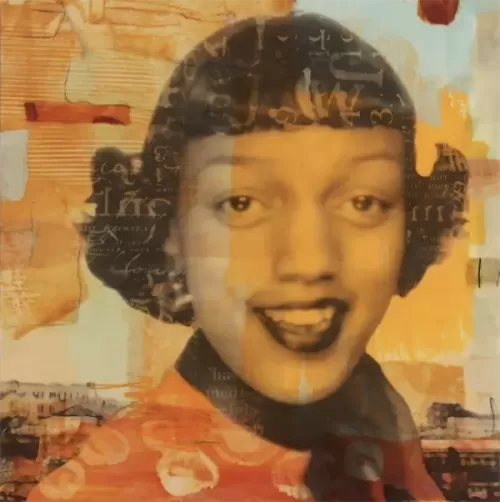
Marybeth Rothman, Augusta, 18 x 18.
MR: This is Augusta. She is more than my process. It’s really about who this person is in the story; the process enhances it for me.
I started collecting old photos, inspired by the family photos my father left me. Augusta was a photo booth image, you know, the little one and a half by two. And it’s from the 40s. I couldn’t find many African American photo booth photos. I had about eight or ten of them that I kept finding over the years, such as one on eBay or at a yard sale, or one would be in a box. And I kind of just kept putting them aside. I said, someday you guys are going to be a group of I don’t know what. When I assembled this group, I was like, ‘Who are you?’ And so I started looking into African American history and came across the Harlem Renaissance, which I know we didn’t learn about in school. It was a fantastic time for African Americans in Harlem. The Hobby Horse, located in Harlem, was the first African American bookstore in the United States. Augusta was part of a series, The Hobby Horse Literary Guild, an imaginary tribute to the Hobby Horse. She was in the Delaware Contemporary Museum for a short time, and on a billboard in Los Angeles as part of a show called The Billboard Creative. She lives in Los Angeles.
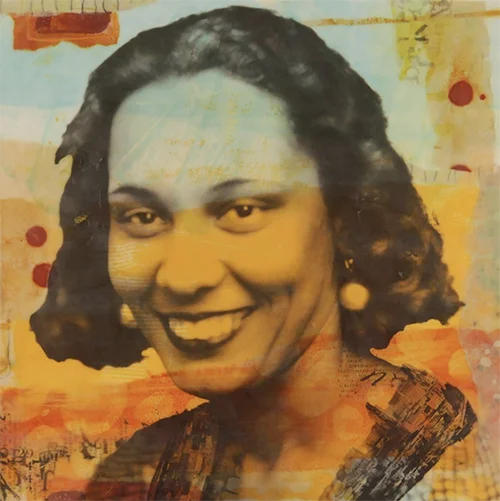
This is Adelaide, and you can see I made her dress into what I imagine New York City was at that point. And all these details that I put on the clothing and in the background, I call biographical annotation.
SMR: Is it something you can read?
MR: They’re never really legible. I don’t know who the people are, so I can’t actually write down their story. I just put a little note there, and maybe it’s what this person’s about. Many of the photographs were in the boxes, and there were numerous documents, as people had emptied Grandma’s house and disposed of photos and documents that told the story of these people. There were little treasures, you know, unexpected treasures, and they became part of all of my imagery.
SMR: Did you keep any documentation in a collection together, or did you use it wherever you needed to use it?
MR: I used it wherever I needed it.
SMR: And the colors, the palette, are similar for that whole series?
MR: Yes. It creates a cohesive unit. Yes, usually I do that.
SMR: I remember noting a textured surface on that.
MR: They’re textured because it’s layered paper. I did a period where I would put the collage down, embed the photo, and then I would cover the whole thing with unpigmented beeswax. And then I decided one day, no, I really like the collage. I like the layers, the nuances — the dots next to Adelaide’s face or that little piece of orange up in the left corner. That’s a piece that’s not a stroke. They’re more delicate, but you really get a sense of dimensionality and layers, which I was looking for in the beginning.
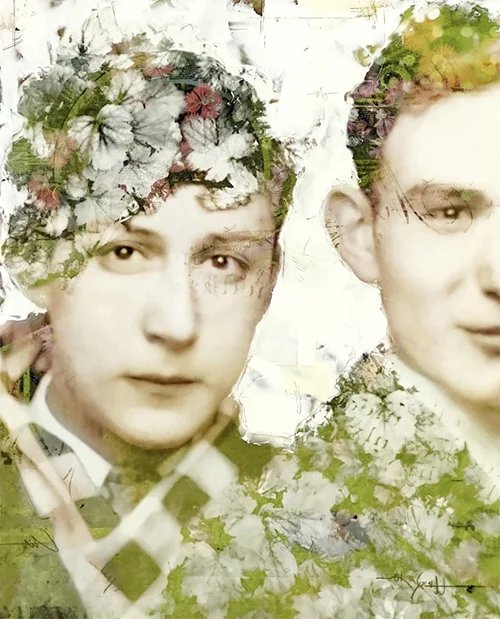
Marybeth Rothman, If They Lived in Paradise.
SMR: You mentioned that a recent series was a little different. Can you explain how you continue to refine and develop your method and vision?
MR: This is called, If They Lived in Paradise. I did it this past spring.
I had made a number of these portraits in black and white with color in the background, like I usually do. They were in my studio, and I thought, “This story is not done. These photos, these portraits, I think there’s more to it. What do I do?” I decided to try doing the full color photo. I have done that before —a full-color photo—but I just kept it on paper. I wanted to create an image on my computer and add color to the old 40s black and white photo, as well as color all the floral elements. They were, in effect, an extension of the original portraits. It was interesting to revisit and remind myself, “Stop making rules for yourself in your studio.” Just because I did these once doesn’t mean I can’t continue the story. It was an interesting experience. The original series was titled “Notable Inhabitants of Beacon Falls.” This series is called Nights Like That, Days Like These. Now in 2025, they’re very involved. So that’s what’s in the background. And I painted the background out and scraped it back.
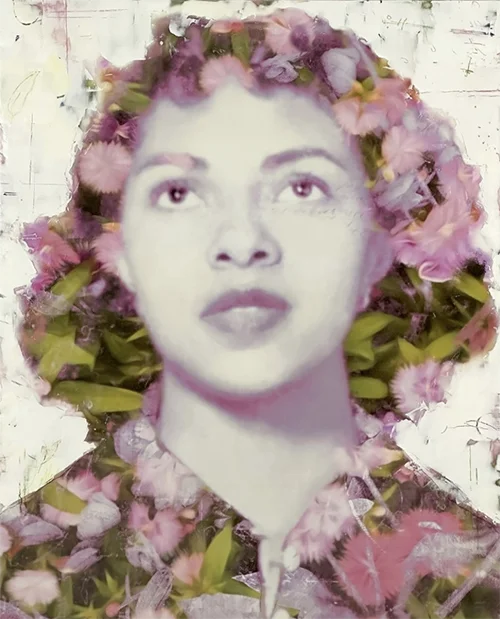
Marybeth Rothman, It Needs to Be Now.
It Needs to Be Now is another one from that series. These are flowers that I have photographed. And then there are graphic elements that have been mixed in. As you can see in the background, I’ve scraped back a lot of the paint, and some of the imagery is coming through. I’ve also drawn into it. It was a much more tactile experience.
SMR: Are there any art trends that have inspired your work, aside from individual artists? I’m reacting to the obstruction of imagery, which seems to be a more contemporary trend where you create opaque gestures or shapes over underlying imagery, yet allow the fact that something is underneath to be apparent. It’s making history in the painting itself, as well as with the painting process.
MR: Yes. And it percolates through, you know, yes, various places.
SMR: Speaking of history, were you a member of NAWA before you became an honorary vice president?
MR: Years ago, and it was great. And then again, my son’s challenges made my life very complicated. It was mom first, artist second.
SMR: Of course. Do you have a network of artists that nurtures and supports you?
MR: Yes, I do, I do. I actually met a number of them through the Encaustic Conference. There’s one particular artist that I can think of, Joanne Matera, who wrote The Art of Encaustic Painting: Contemporary Expression in the Ancient Medium of Pigmented Wax.
I found the book and started painting on my own for a year. And there was just something I wasn’t doing right. I called the company that makes the paints, R&F Handmade Paints, and I asked, ‘Do you offer workshops?’ And they’re like, “Yeah, yeah, we do group workshops.” I said, “No, I don’t want to do a group workshop. I would like to bring Joanne Matera’s book to you and review each page and either try it or talk about it.” And I spent two days with this woman up there. And by the afternoon, she said to me, “My head hurts, there’s nothing left.”
Then I kind of got into this community. Joanne Matera held conferences in Salem, Massachusetts, and then moved them to Provincetown, which is measurably more fun than Salem. And we just kept coming back. We were a group attending the lectures, and eventually, we became the lecturers. It’s still going very strong. Being together with artists for a weekend is truly amazing. The people I became closest to, just coincidentally, were also from New Jersey. So we’re in each other’s lives.
SMR: When you get together, is it just a social situation? Do you critique?
MR: We critique. And it’s social. We’re very supportive of each other.
SMR: Do you have any other interests that influence your art outside of this fascination with the photographic images? Are there any other interests that you have outside of that?
MR: I work in my studio seven days a week.
SMR: Looking at all the flower imagery, I wonder if you have a garden that inspires you?
MR: No. Any hydrangeas that you see in my work were planted behind my studio. For someone who loves flowers and things as much as I do, I can’t grow anything, but my sister can grow anything.
I’m always just working.
SMR: How big is your studio?
MR: 18’ x 24’.
SMR: That’s a nice-sized area. Is that within your home or outside your home?
MR: I’ve always had my studio in my home because I was raising my children.
And then we moved about almost eight years ago to an age-in-place home. We built our home on one floor. My studio had always been in the basement of my house.
Now, it’s right off the kitchen. And I have gorgeous light. I’m in here, my cup of tea and my pajamas in the morning, looking at yesterday’s work, and then I sneak in after dinner. In the summer, the light that comes in here after, you know, six or seven in the summer. I can’t not be in here. When it’s dark, it’s harder to come in at night in the winter.
SMR: The fact that you positioned your studio so close to the kitchen brings to mind whether you find that you have to balance your art and studio practice with your life.
MR: Definitely. I plan it, but artwork comes first. I want to wake up unencumbered by the universe. And I get to work. And then I deal with other stuff later in the day.
Before I open my eyes, I try to think about what I’m going to be doing in my studio that day. And it’s great. It’s a good way to start the day. I don’t just start right away at the computer. It’s not healthy. I love collaging my work. My studio practice, if I had to sum it up, or my creative process, in one word, is circular. I create these photographs and these monotypes. But I don’t use all of them. I print a photo eight times before I’m satisfied with it, but I keep it. And I then use those in works on paper.
You know, I’ll make abstract work because there’s something more to be said with these materials. It’s just not all told in a portrait. And I do a lot in sketchbooks, collage sketchbooks. Or I’ll draw with ink; that’s a nice way to be meditative in the morning and kind of get centered. And I try to do that every day. And it leads to more work.
I’ve also created a series of abstract works. They’re separate, but related. Sometimes I’ll work on the abstract, you know, the works on paper during the day. If I need a break from what I’m doing, or if my computer work gets too intense, or I need to step away from my portrait work. I have a table in the middle of the studio. And that’s basically what that’s for.
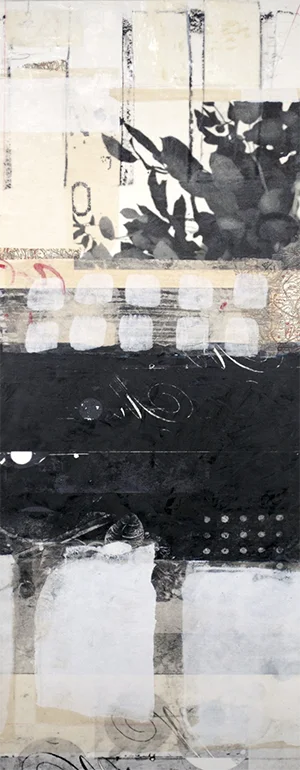 MR: This is a piece from the Longford Journals. Photo and pigmented beeswax on Kozo paper and wood panels, these are parts of paintings, these monotypes. My materials just keep moving through my studio. They’ll be small. They’ll be in a sketchbook. They’ll be on a finished painting.
These pieces from the Longford Series are 48 inches by 18 inches and have been exhibited independently. I’ll have abstract shows and portrait shows. Someday I’m going to figure out how to put them together.
SMR: I’m looking forward to seeing that.