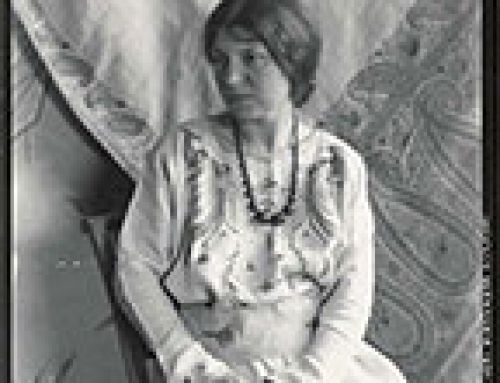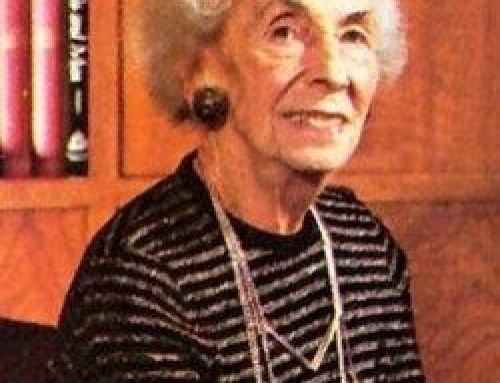

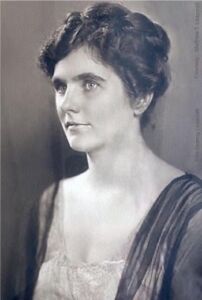
 A remarkable show at the Woodstock Artists Association & Museum, Unconventional Perspective: Works by Julia Leaycraft 1885-1960, assembled the NAWA historical members’ works for the first time in 75 years. The retrospective, featuring over 30 paintings, lithographs, and drawings, traces the creative evolution of one of the Woodstock Art Colony’s celebrated voices. Spanning over five decades of Julia Searing Leaycraft’s life and art, the exhibition “invites visitors into a deeply personal yet socially resonant world shaped by beauty, independence, and meaning found in everyday life.” 1
Julia Searing, the daughter of John Welch Searing and Annie Eliza Pidgeon Searing, was born in 1885 in Saugerties, New York, and grew up in Kingston, New York.Her father was a prominent lawyer, civic leader, and the owner and editor of the Kingston Daily Leader. Her mother, Annie Pidgeon Searing, was a well-published fiction writer and a suffragist, noted for sharing the speaking stage with her friends and colleagues, Elizabeth Cady Stanton and Susan B. Anthony. Julia’s family’s accomplishments go back even further: her grandfather, Frank Pidgeon, was a noted baseball player in the nineteenth century.
Julia and her sister Isabelle grew up in a household that valued art, culture, and education.2 Family friends included the Hudson River School painter Jervis McEntee, his cousin, the painter Julia Dillon, and members of the Thomas Cole family.
Julia attended Kingston Academy and, like her mother, attended Vassar College. She graduated as president of the Class of 1906, and continued her studies in art for three years at the Art Students League of New York with William Merritt Chase, F. Luis Mora, and Frank DuMond. In addition, between 1907 and 1910, she attended summer sessions at the Woodstock School of Landscape Painting, under Birge Harrison, John F. Carlsen, and Walter Goltz.
In 1909, having concluded her studies, Julia, unlike most women of her era, decided to get a job and live independently. Seeing herself as a writer as much as a painter, she sought work in publishing and became an art reviewer and editor at Gustave Stickley’s Craftsman Magazine. Later, as a managing editor of the Delineator, a popular women’s magazine featuring fashion, culture, and fine arts, she worked closely with its senior editor, Theodore Dreiser, who became a lifelong friend.3
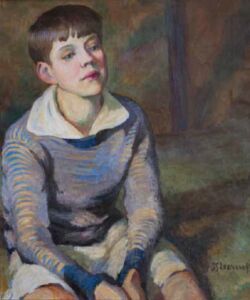
Julia Searing Leaycraft, Portrait of Peter(The Artist’s Son), c. 1926, oil on canvas, Woodstock Artist Association and Museum.
During the early years of her marriage and motherhood, Julia continued working. During World War I, she was head of magazine publicity for the War Work Council of the Y.W.C.A., and later taught art at the Slater Museum in Norwich, Connecticut. She became active in women’s causes, founding and serving as the first president of the Intercollegiate Bureau of Occupations, the first employment agency for college-educated women in the United States.
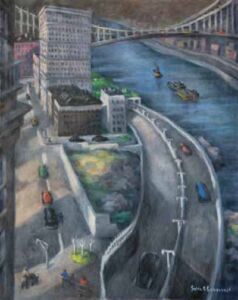
Julia Searing Leaycraft, East River, Oil on canvas, courtesy of the Woodstock Artists Association and Museum.
Julia was also a founding member of a progressive women’s public advocacy group, the Women’s City Club of New York. Membership was by invitation and limited to one hundred members, among them workers’ rights advocate Frances Perkins, who later became secretary of labor under President Franklin D. Roosevelt, and progressive journalist Ida Tarbell.5
Julia, along with her children, began living apart from Edgar for most of the 1920s, spending all or part of the year in Woodstock, New York. There she was able to focus on her art and live in a like-minded community of artists and intellectuals.6 She became very close friends with the Woodstock painter Anita M. Smith, a NAWA member (1918), who became a historian of Woodstock as well as an herbalist. Together, they shared a house in Lake Hill for the winter of 1922 and 1923.
From 1924 to 1928, Julia and her children lived in an 18th-century gristmill that had been converted to a unique house by her friends, the artist Carl Eric Lindin and his wife Louise. She had a large studio on the second floor, where she painted the portrait of her son, Peter.
Julia began spending a good part of every summer traveling in Europe, sometimes taking the children along when they were not with their father. In 1928, the Dalton School in New York City offered her the Chair of the art department. During her tenure, she developed the curriculum for an art history survey course, which was accepted for academic credit by Vassar, Smith, Mount Holyoke, Wellesley, and Wheaton Colleges.
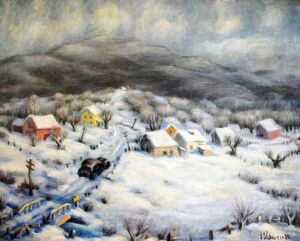
Julia Searing Leaycraft, Snowy Road, 1938. Historical Society of Woodstock Archives
Julia and her husband amicably divorced in 1929, and she lived without a partner for the rest of her life. She left Dalton in 1933 and divided her time between New York and Woodstock, a pattern that continued for the next twenty-five years. From 1933 to 1940, Julia published a weekly column, Art Notes, in the Ulster County News, writing thought pieces concerning art, the Woodstock colony, and new developments in contemporary art.7. Still, Julia made it a practice to spend a fixed amount of time in the studio each day, regardless of the actual artistic outcome.8
At this time, Julia engaged Woodstock painter Henry Lee McFee to provide periodic private critiquesof her work. Also, she sought critical insight from her artist neighbor and friend, Henry Mattson. Her work of the 1930s and 40s represents her mature style, incorporating elements and themes then prevalent in contemporary American Scene painting. An undated work titled East River depicts a view from high above overlooking the newly constructed FDR Drive, then a wonder of modernity.9
In 1936, writing in The Beacon, the monthly journal of the Theosophical Society, Julia described the artistic and life process as she had come to understand it:
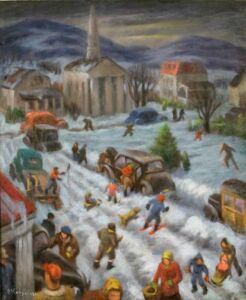
Julia Leaycraft, Village in Winter, c. 1940, Oil on canvas, 30 x 25 inches. Woodstock Artists Association & Museum, Gift of Mr. and Mrs. Edgar C. Leaycraft, 1982-10-01.
“There is a very fine line of difference between the religious mystic, meditating until he received a “call from God,” and the artist freeing himself of personal aims and desires in order to be the channel for the “innate drive that seizes a human being and makes him its instrument,” as Jung put it … All expression is performed with remembered emotion – emotion poured through a relentless analytical process. [If the emotional] force is not translated into expression, it atrophies, or it becomes a nebulous set of feelings. It can become, on the other hand, the source of soul power, if the personality has grasped it and held it, like the hero of old, through all the terrifying changes of shape.” 10
In 1938, Julia was president of the Citizens Committee of the NYA (National Youth Administration) Crafts Center in Woodstock. A nationwide pet project of Eleanor Roosevelt, who took an interest in the Woodstock location, the NYA’s primary objective was to train young people, especially those living in rural areas, in various practical skills and crafts. The committee organized planning and funding for the Center, as well as the construction of its buildings and staffing. The location is now home to the Woodstock School of Art.11 She also served on the board of the Woodstock Library as a trustee and then as president, helping it continue its existence after World War II.12
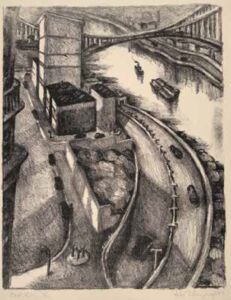
Julia Searing Leaycraft, East River, 1952, lithograph. Woodstock Artists Association & Museum.
During her career, Julia exhibited regularly at the Woodstock Artists Association (now WAAM). She became a member of the National Association of Women Artists in 1944, exhibiting regularly in the annual members’ show through 1948 and again in 1952 with her lithograph, East River. The Connecticut Academy, the Albany Institute of Art, and Artists Equity, of which she was a member, all exhibited her work. In 1948, she had a one-person show at the Mitchell Gallery in Woodstock and a solo exhibit at NAWA’s Argent Gallery on 57th Street, then a prime location for contemporary galleries. There were a total of 20 works in the show, including The Bridge, the oil painting titled East River in the WAAM exhibit. The signed guest list for the show and the prized cards and telegrams, stored in a scrapbook, speak to the exhibit’s meaning for Julia.13
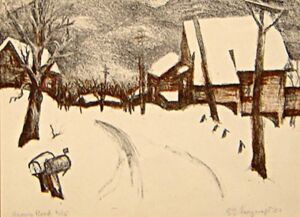
Julia Searing Leaycraft, The Snowy Road, 1950, lithograph on paper. The Historical Society of Woodstock Archives.
Speaking before the Columbia County Arts and Crafts Guild in 1950, she asked, “Why Do People Paint?” and answered:
“The impulse to paint always comes from attraction, —if you wish to put it more directly, from the emotion of love. . . . It is an emotion response that must be expressed. . . . The pure copying of nature is not art at all, —a photograph can do this better.” She continued: “the final ideas come from within, and are more or less fully developed… before setting them on canvas. This kind of painting I would call ideational art.” She concluded with, “How better is happiness pursued than in the constant endeavor to express thoughts and feelings that are peculiarly our own?” 14
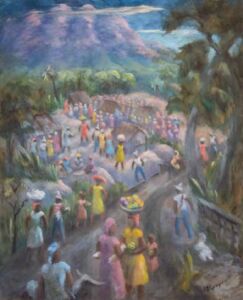
Julia Searing Leaycraft, Haiti market, Oil on canvas, 1953. Woodstock Artists Association & Museum.
Julia’s last years were primarily devoted to the needs of her daughter, who became seriously incapacitated by multiple sclerosis.15 She died in New York City in 1960.
Sources:
https://www.chronogram.com/author/brian-k-mahoney/
2,3,4,5,6,8,14https://www.learningwoodstockartcolony.com/post/julia-searing-leaycraft-independence-identity-and-a-woman-s-life-as-an-artist
10Leaycraft, J., “Creation and Expression,” The Beacon, March and April 1936. Published by the Theosophical Society.
7,14 Leaycraft, M., “The Process of Becoming,” catalog essay for Unconventional Perspective: Works by Julia Leaycraft, Woodstock Artists Association and Museum, Woodstock, New York, 2025.
11,12https://en.wikipedia.org/wiki/Julia_Searing_Leaycraft
1HTTPS://WWW.WOODSTOCKART.ORG/EVENT/UNCONVENTIONAL-PERSPECTIVE-WORKS-BY-JULIA-LEAYCRAFT/
9Wolf, T., “The Paintings of Julia Leaycraft,” catalog essay for Unconventional Perspective: Works by Julia Leaycraft, Woodstock Artists Association and Museum, Woodstock, New York, 2025.
13 personal communication with Matthew Leaycraft, January, 23, 2026.
—
Susan M. Rostan, M.F.A., Ed.D. Website
Historian, NAWA Historical Research, NAWA Luminaries
Email: NAWA Historian
Signature Member of the National Association of Women Artists
NAWA. Empowering Women Artists Since 1889