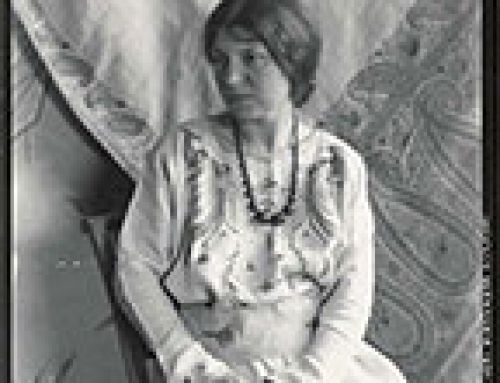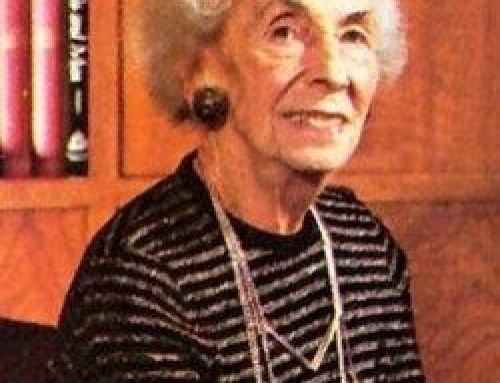

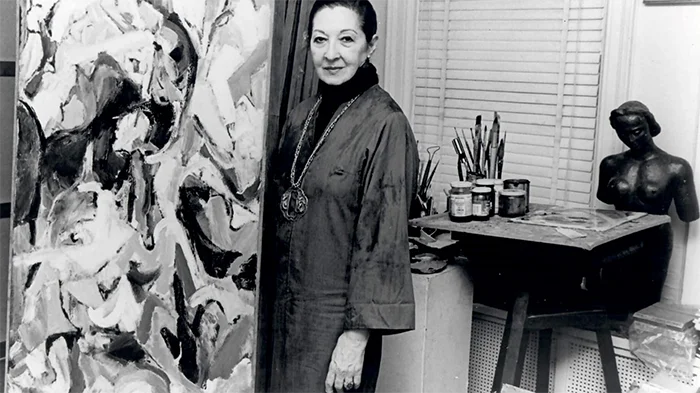
Anna Walinska with her painting The Naked and the Dead, which is now in the collection of the Eskenazi Museum of Art. Courtesy of Rosina Rubin
An American painter and celebrated NAWA member, Anna Walinska was a prolific artist, creating more than 2,000 works on canvas and paper throughout her lifetime. She is known for her colorful Modernist works, collages done with handmade Burmese Shan paper, and a large body of works in response to the Holocaust.
Her work related to the Holocaust is currently featured in the exhibition “Remembrance and Renewal: American Artists and the Holocaust, 1940–1970,” at the Eskenazi Museum of Art at Indiana University Bloomington.
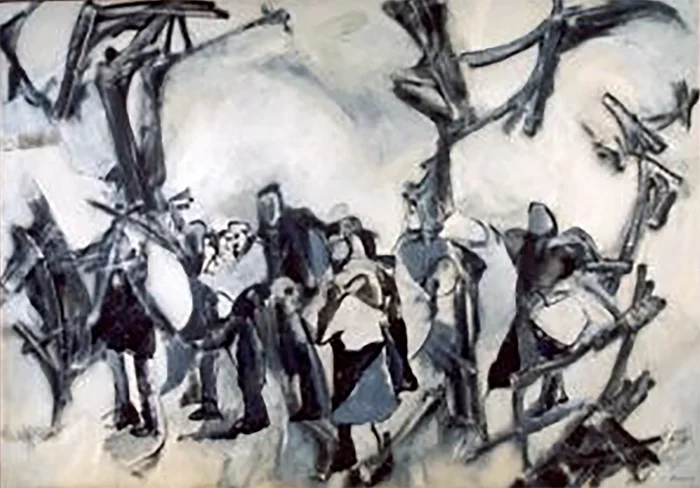
Anna Walinska, Survivors – Exodus, 1958, in the collection of the Eskenazi
Museum of Art. Courtesy of Rosina Rubin.
The Forward recently interviewed Rosina Rubin, Anna Walinska’s niece and a member of the NAWA Board of Directors, about Walinska’s Holocaust Series and the work on display at the Eskenazi Museum of Art. The painting, Survivors – Exodus Survivors, in the Eskenazi Museum’s permanent collection, was part of a series exhibited in her 1979 show at the Cathedral of St. John the Divine in New York. It is one of Walinska’s largest works on canvas and appears on the cover of the exhibition catalogue published by Yale University Press, as well as on postcards for the gift shop.1
Walinska did not have any direct contact with the Holocaust, but she did live in a solidly Jewish immigrant neighborhood in New York in the 1930s, close to people who lost friends and family. In an interview with Dr. Judith Shapiro on radio station WEVD in November 1979, Anna Walinska answered the question of how she happened to dedicate herself to the Holocaust in her work with: “I must speak of my parents, generations of my immediate family [who] were and are engaged in Jewish public service. How could I help but be profoundly involved and influenced by their activities?”
Rubin explained that the trauma of this period prompted Walinska to paint a series depicting the stories she heard and the despair that the Jewish community felt: “She often said that those of us who were living were all survivors. We’re survivors of what happened. We carry the stories with us.”
Rubin estimated that there are about 100 works in the entire series and that “Unlike Walinska’s earlier paintings, which had used bright bold colors, her post-Holocaust work was composed primarily of blacks, whites, and browns, meant to represent death, silence, and return to the earth, respectively.”
The Museum’s state-of-the-art conservation studio undertook a complete restoration of the painting, which they discovered Walinska had created using both oil and spray paint. Conservators used hydrogels to gently and effectively remove the dust and grime that had accumulated over the years in storage, without damaging the original water-sensitive paint beneath.
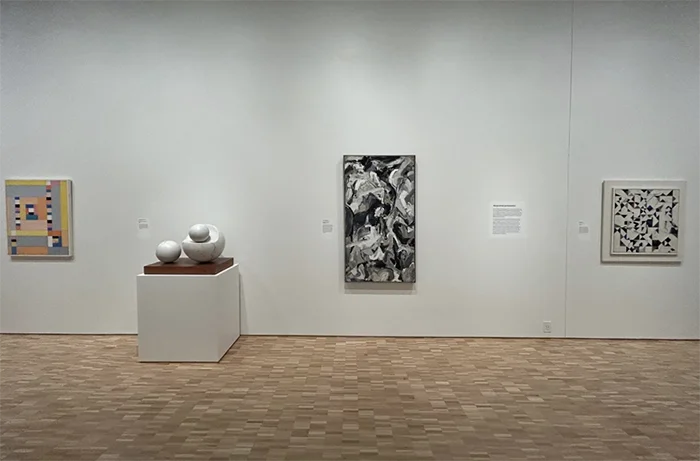
Anna Walinska, The Naked & The Dead, 1957, In Women Artists and Abstraction, the Eskenazi Museum of Art at Indiana University Bloomington. Courtesy of Rosina Rubin.
Rubin noted that in addition to Survivors — Exodus, “there are several of Walinska’s drawings that illustrated The Gate Breakers by Israeli journalist Bracha Habas (Herzl Press, 1963). And, in the gallery next door, in the current rotation of the Museum’s permanent collection featuring work by women abstract artists, is an additional work from the Holocaust group – The Naked & The Dead, 1957, oil on canvas.” 2
Over her lifetime, Walinska created more than two thousand works on canvas and paper, many of which are in collections that include the United States Holocaust Memorial Museum, the High Museum, the Herbert F. Johnson Museum of Art at Cornell University, and Yad Vashem. S
For those interested, the Eskenazi Museum is having a streamed symposium on Jewish art on November 17, 2025.3
Sources:
https://forward.com/culture/art/764590/anna-walinska-eskenazi-museum-of-art-holocaust-exhibit/
1,2,3 Email communication with Rosina Rubin on October 15, 2025.
Susan M. Rostan, M.F.A., Ed.D. Website
Historian, NAWA Historical Research, NAWA Luminaries
Email: NAWA Historian
Signature Member of the National Association of Women Artists
NAWA. Empowering Women Artists Since 1889