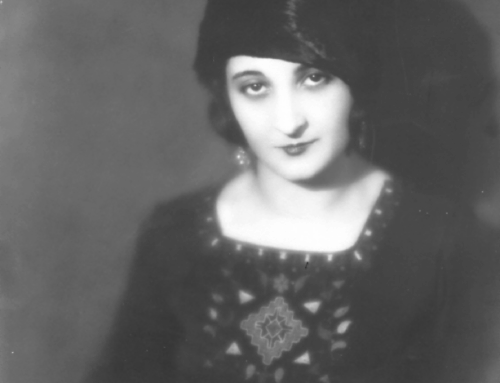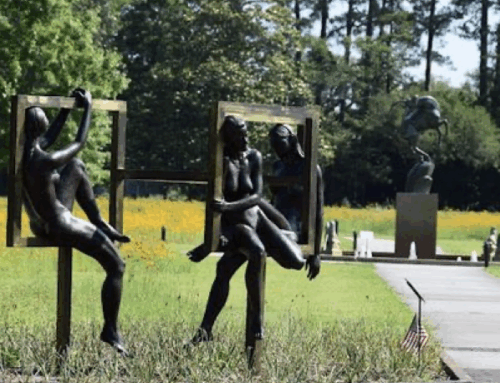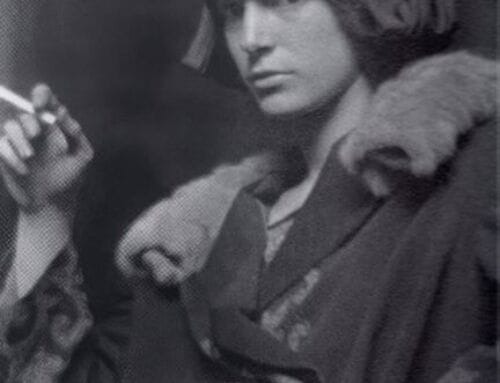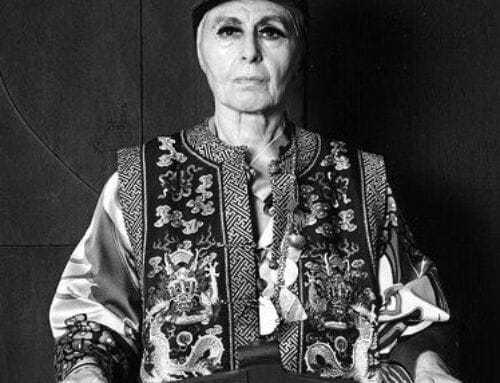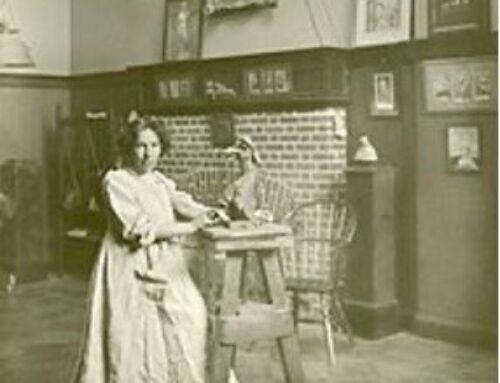

Site Santa Fe’s “Once Within a Time,” a citywide exhibition of work by 71 regional, national, and international artists, is on view through January 12, 2026. The exhibition takes its title from “Once Within a Time,” a 2022 film by Godfrey Reggio, an 85-year-old filmmaker and longtime Santa Fean. The star theme at Site Santa Fe is “In Touch With Light,” a section that explores New Mexico’s energies, both healing and destructive, in a region whose mystical landscapes have long drawn outsiders seeking spiritual energy boosts. One of the artists on display was the visionary symbolist painter Agnes Pelton, a historical member of NAWA, who gravitated to Taos in 1919 and produced otherworldly images.
Agnes Lawrence Pelton (1881-1961)
by Susan M. Rostan, MFA, EdD
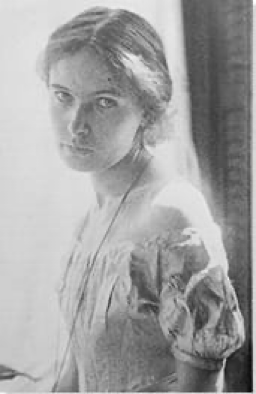
Agnes Pelton (1881 – 1961) was a pioneering American modernist whose nature-based abstractions, begun in the mid-1920s, established a new direction for progressive painting in this country. Pelton’s works were poetic celebrations of nature that explored the vital forces animating the physical world. Interested in themes of creation, growth, and radiance, she translated favorite subjects — a glowing star, an opening flower — into life-affirming images of rare beauty and resonance. Her unusual designs, intangible forms, and exquisite color recorded visual impressions that were more vivid to her than the observable experiences of the world.
Agnes Pelton was born in 1881 in Stuttgart, Germany, to American parents Florence and William Pelton. Her maternal grandfather was American abolitionist Theodore Tilton, and her paternal grandfather was a plantation owner in Louisiana.1 Her earliest years were spent traveling around Europe, visiting America with her mother, and living in Rotterdam, the Netherlands, from 1882 to 1884 and in Basel, Switzerland, from 1884 to 1888.2 In 1888, Agnes and her mother emigrated to America in Brooklyn, New York, where they lived with Agnes’ maternal grandmother Elizabeth Tilton.
Her father, William Pelton, did not settle in America with his family, preferring instead to continue traveling throughout Europe and only occasionally visiting his wife and daughter. William suffered from several psychological issues and experienced intense mood swings, melancholy, and insomnia. In 1891, when Agnes Pelton was just nine years old, her father died of a morphine overdose in her paternal uncle’s home in Louisiana. His death had a significant impact on her. She withdrew into herself, becoming quiet and private, later noting that: “from the time of puberty at age thirteen, I was much inclined to melancholy and tears, which was probably aggravated by being the only child in a household of deeply religious and perhaps unnecessarily serious people.”3 Due to her poor health, Agnes was educated at home. At the same time, her mother, Florence, who had studied music at the Stuttgart Conservatory of Music, operated the Pelton School of Music from the family home in Brooklyn for 30 years.
In 1895, at the age of fourteen, she enrolled in the general art course at Pratt Institute, studying with painter, printmaker, and photographer Arthur Wesley Dow. Dow was a notable figure in American art education, probably best known for instructing Georgia O’Keeffe. Pelton graduated in 1900 with classmate Max Weber, another early American modernist, continuing her studies in landscape with Dow in his summer program in Ipswich, Massachusetts, where she was his assistant.4 Biographer Tiska Blankenship noted that “Dow emphasized structure, spirit, imagination, creation, and the nonnaturalistic use of color, a technique he taught using Japanese prints to demonstrate space relations and the appropriate use of light and dark masses… Dow’s influence was critical to Pelton’s development of abstractions based on interior, spiritual values.”5
Pelton continued her studies in summer classes with American Impressionist William Langson Lathrop in 1907, followed by a year abroad in Italy in 1910, where Hamilton Easter Field, another of her Pratt instructors, was residing. Under Field’s guidance, she studied Italian painters and daily life drawing at the British Academy in Rome.
During the 1910s, Pelton had located her studios at the center of radical politics and avant-garde art, Greenwich Village. Influenced by her studies and her outdoor explorations of the effects of natural light, in 1911, she began to produce her first independent works: a series of symbolist figure compositions in pastoral settings that she called her “Imaginative Paintings,” continuing in this direction through 1917. Inspired by the art of Arthur B. Davies and his Symbolist worlds of mythology, dreams, and allegory, like Davies, Pelton painted nude women cavorting in dream landscapes recalling the British Romantic poets and turn-of-the-century European aestheticism.6 Pelton wrote that they represented “moods of nature symbolically expressed.”7
Field exhibited her work in his Ogunquit, Maine studio in 1912. Based upon her work at that show, American painter Walt Kuhn invited her to participate in the 1913 Armory Show. Although Robert Henri conceived of the extensive exhibit, two of Henri’s students, Walt Kuhn and Walter Pach, and a Henri contemporary, Arthur B. Davies, did most of the legwork.8
In January 1912, the three joined some two dozen colleagues in establishing a broad-based professional coalition, called the Association of American Painters and Sculptors, which anticipated providing two things: exhibition opportunities for young artists, American and foreign, operating outside academic boundaries; and educational art experiences for the greater good of the American public. Their only success was in creating the International Exhibition of Modern Art, known as the Armory Show, in New York City‘s 69th Regiment Armory, on Lexington Avenue between 25th and 26th Streets, from February 17, 1913, to March 15.
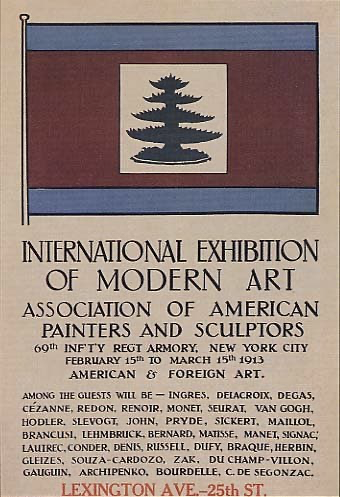
The Armory Show became a legendary watershed date in the history of American art, introducing many New Yorkers, accustomed to realistic art, to modern art. Displaying some 1,300 paintings, sculptures, and decorative works by over 300 avant-garde European and American artists, among them fifty women artists,9 twenty of whom were, or would become, National Association of Women Painters and Sculptors members (*see list at the bottom of the article). The Women’s Art Club, the first iteration of NAWA, had changed its name to the NAWPS that year.
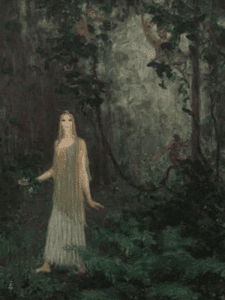
Agnes Pelton, Vine Wood, oil, c. 1913
Pelton’s oils, Vine Wood, and Stone Age, were included in that landmark show. In Vine Wood, a female figure walks through a forest, with her large, dark eyes and long, auburn hair in stark contrast to her pale skin. Dressed in a long, flowing gown in the palette of the woods, lends an ethereal quality to her presence.
Agnes Pelton became a member of the National Association of Women Painters and Sculptors in 1918. Following a visit in 1919 to Mabel Dodge Sterne Luhan, a wealthy American patron of the arts associated with the art colony in Taos, New Mexico, Pelton’s work changed significantly. She painted in oil and used pastels to create realistic portraits, desert landscapes, and Native Americans. She would return to these themes throughout her career.
Pelton exhibited in various New York galleries, such as McBeth and Knoedler, in the 1910s and 1920s, as well as a solo show in Santa Fe at the School of American Research 10
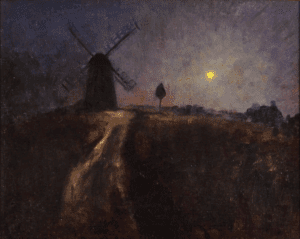
Agnes Pelton, Hayground Windmill, circa 1920. Lincoln Glenn Gallery
Pelton kept her studios in Greenwich Village in New York City until 1921, when her mother died and Pelton’s life and art changed radically. Without her mother’s financial support, she left Manhattan and relocated to a rural environment in a historic Hayground windmill converted to a house in Water Mill, near Southampton, Long Island. Pelton’s life became a quest for peace and solitude. She was captivated by the seclusion of her quaint windmill home: a “mystical house, reaching into heaven and radiating from its center, distributing sustenance.”11 In this spiritual environment the artist turned inward and began to paint abstractions based on natural phenomena It was also when she started to use notebooks to record her most personal thoughts on life and more spiritual issues.
From 1921 to 1932, she traveled to Hawaii, New Hampshire, Beirut, Syria, Georgia, and Pasadena. She painted portraits and still lifes in Hawaii in 1923 and 1924. She created abstract works of art beginning in 1926, which were exhibited in the NAWPS annual exhibitions and in their New York Argent Galleries and the Museum of New Mexico. By 1926, she had shown in 20 group exhibitions and 14 solo exhibitions.12
Agnes Pelton, Fire Sounds, 1930.[/caption]In 1930, she met Dane Rudhyar, an astrologer, composer, and philosopher, and began a close friendship with him that lasted through the 1950s. Rudhyar introduced Pelton to Agni Yoga, an esoteric offshoot of Theosophy. It is the yoga of fiery energy, of consciousness, of responsible, directed thought. This focus provided her work with spiritual content and direction.
On December 7, 1930, Pelton wrote about her work: “These pictures are conceptions of light – the essence of fire, not as we see it in the material world but as the radiance of the inner being. They are produced from that state of consciousness from which the creative impulse is a unified expression and solidified to the presentation of the material forms of the natural world.”14
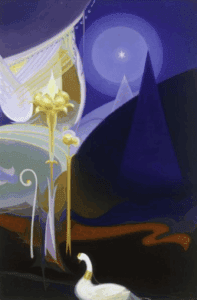
Agnes Pelton, Ahmi in Egypt, oil, 1931.
Dane Rudhyar authored the catalog foreword for Pelton’s 1931 solo exhibition of twenty-one unique abstractions at NAWPS’s Argent Galleries at 42 West 57th Street in New York City. Rudhyar noted: “Her paintings radiate vitality and power. They speak a language of beauty, where colors are vowels and forms consonants. Each painting is a compelling word of a tongue that everyone may understand who, for a moment, withdraws within his or her self and tunes in with the universally human stream of living experience. The forms are clear, precise and strong. Colors glow with an inner warmth. It will do no good to scan the walls hurriedly looking for ‘patterns’ or unusual subject matter. Each painting should be met as we meet a stranger who might become a friend or beloved. Then each will become a living voice, a voice vibrant with the quest for this ultimate reality which, underneath our hectic materialism, is burning within us all.”15
The last phase of Pelton’s life began in 1932, when the windmill was sold by its owner. At the age of fifty, Pelton traveled cross-country and settled in Cathedral City, a small town adjacent to Palm Springs, California. She originally planned a short stay, but remained for the last thirty years of her life, taken by the region’s stark beauty. Pelton explained, “The vibration of this light, the spaciousness of these skies enthralled me. I knew there was a spirit in nature as in everything else, but here in the desert it was an especially bright spirit.”16 Her California abstractions captured the region’s glowing light and vibrant aura.
Pelton did not abandon her classical training when she expanded her vision into abstraction. Her visions evolved side by side. Pelton was well-informed and involved in the philosophical interests of her time; her reading list included an emphasis on esoteric literature. She had read Mme. Blavatsky’s original publications on Theosophy, as well as Dane Rudhyar’s 1929 writings on Agni Yoga. She had a close friendship with modern transpersonal astrology pioneer Dane Rudhyar and Modernist Southwest painter Raymond Jonson. Rudhyar recommended Pelton’s work to Raymond Jonson early in 1933. Jonson invited Pelton to include her paintings in the “Santa Fe Fiesta” group exhibition with him and Cady Wells at the Museum of New Mexico. Jonson and Pelton began a warm and long friendship primarily through correspondence over the years.
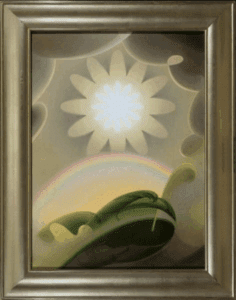
Ages Pelton, Sand Storm, oil, 1932
In 1938, Pelton and Raymond Jonson co-founded the Transcendental Painting Group. The oldest member, she served as the first president, though she had not been in New Mexico since 1919 and did not return there. She the only member who did not reside in New Mexico.
The Transcendental Painting Group originated with a small group of painters working in New Mexico who shared an interest in abstract and non-objective art. Though Agnes Pelton maintained only distant involvement due to geography, she served as an influential figure for the collective. The group primarily organized to defend and validate abstract and non-objective art, which the public regarded as anathema to classical aesthetics and morally questionable, leading to its rejection from exhibitions. They aimed to transform public attitudes, thereby securing exhibition opportunities and expanding art’s horizons. The younger members of the group looked to Pelton as a role model, admiring her ability to pursue an independent artistic vision while working far removed from any major art community.
In Agnes Pelton, Poet of Nature, author Michael Zakian notes that total non-objectivity held no meaning for Pelton; she felt it lacked heart, soul, and emotion. Pelton did not want to invent non-objective structures; she desired to penetrate reality’s veil, to reveal deep forces beneath surface appearances. Even when culled from recesses of imagination, her forms allude to concrete objects in real space, surrounded by an envelope of light and air that alludes to our spatial environment. She was also indifferent to modernism; she never employed a flat, planar style or used abstract form as an end in itself. She opposed the use of rigorous analysis to pare form to its essential elements. Painting was always a descriptive enterprise. She strove to pay nature homage, not to rival it.
The group was successful in bringing the term transcendental to prominence, and their application of the term to their work advanced the meaning of abstraction or non-objective art and established the concept of the sublime, meaning high spiritual and intellectual worth. Representing an ideal condition or one of expanded awareness and acceptance of ideas and behaviors, the group believed it had the potential to enlighten cultural values.
For the TPG, the term spiritual conveyed something other than religious meaning. It was something reached from a process of refining integrity, skill, knowledge, and experience into an artistic statement conveying openness and acceptance. They viewed it as ultimately inspiring for the human condition. The term transcendental was tied to quality, as was the concept of ideal, because work lacking in quality could not represent an ideal, and therefore could not approach the spiritual.
A manifesto, published in 1938, stated that the group’s purpose was “to carry painting beyond the appearance of the physical world, through concepts of space, color, light, and design, to imaginative realms that are idealistic and spiritual.” The manifesto included the statement that “the work does not concern itself with political, economic, or other social problems.”16
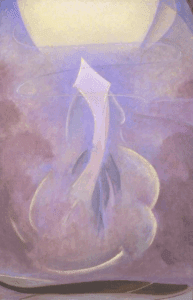
Agnes Pelton, Ascent, oil, 1946.
Pelton was honored, during the 1930s and 1940s, with one-person exhibitions at all of California’s major art museums, including the San Francisco Museum of Modern Art, the Santa Barbara Museum of Art, the Laguna Art Museum, and the San Diego Museum of Art. Unfortunately, interest in her work declined after World War II. Pelton had no family and lacked the energy and charisma to promote herself actively.17
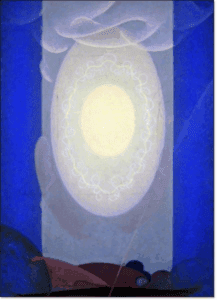
Agnes Pelton, Light Center, oil, 1961.
On January 12, 1957, four years before her passing, Pelton wrote: “Though Art lends itself willingly to illustration of mental concepts and presentation of human and natural forms, art within its own Field can contribute to the apprehension of spiritual life, and the expansion of a deeper vision. Of all the arts, painting is the foremost in the use of color, having within its scope the possibility of the direct communication of its vibratory life and essential element in light.”18
Throughout her career, she had expressed the spiritual in abstraction, inviting others to visualize and consider other possibilities of expressing reality through beauty.
Pelton died financially poor in Cathedral City in 1961, just before she turned eighty, and was cremated. Her ashes were buried in the San Jacinto Mountains.
Pelton and her art remained relatively obscure on the national level until the 1995-1996 tour of a retrospective exhibition of her work, entitled Agnes Pelton, Poet of Nature, curated by Michael Zakian and originated out of the Palm Springs Desert Museum. Agnes Pelton: Desert Transcendentalist, the first survey on her work in over two decades, debuted at the Phoenix Art Museum in 2019 before traveling to the New Mexico Museum of Art in Santa Fe and the Whitney Museum of American Art in 2020.
The Agnes Pelton Society was founded in 2013 to promote Pelton’s life and legacy.
Sources:
https://www.aaa.si.edu/collection-features/1913-armory-show
https://www.artforum.com/features/chloe-wyma-on-the-art-of-agnes-pelton-246586/
5,10,12,14,16,18 Blankenship, Tiska. “Agnes Pelton and Florence Miller Pierce: The Two Women Artists in the Transcendental Painting Group”. Women Artists of the American West. College of Liberal Arts, Purdue University.
Doss, Erika. Spiritual Searching in Modern Times: Agnes Pelton’s Desert Transcendentalism.https://www.youtube.com/watch?v=OGuDPVK1_YE
oduction
5 http://www.elisarolle.com/queerplaces/a-b-ce/Agnes%20Lawrence%20Pelton.html
15 https://www.newspapers.com/article/the-courier-news-agnes-pelton-1931-exhib/17772035/
11Pearce, Michael, American Fine Art Magazine, May 1, 2023. https://www.lincolnglenn.com/press/11-modernist-mystic-agnes-pelton/
2 Severson, Don R. Finding Paradise: Island Art in Private Collections, University of Hawaii Press, 2002, p. 120. ISBN 978-0-937426-55-5.
91913 Armory Show; 50th anniversary exhibition, 1963. Organized by Munson-Williams-Proctor Arts Institute. Sponsored by the Henry Street Settlement, New York. [Utica, 1963],
2 https://www.theartstory.org/artist/pelton-agnes/
https://www.wikiart.org/en/agnes-lawrence-pelton/light-center-1961
4,10 https://en.wikipedia.org/wiki/Agnes_Lawrence_Pelton
13 https://en.wikipedia.org/wiki/Agni_Yoga
10 https://en.wikipedia.org/wiki/Armory_Show
1,3, 6,7.16,17Zakian, Michael (1995). Agnes Pelton: Poet of Nature. California State University, Sacramento Library: Palm Springs Desert Museum. p. 17. ISBN 0-295-97450-8. https://tfaoi.org/aa/9aa/9aa269.htm
*List of NAWPS members in the 1913 Armory Show:
Florence Howell Barkley, 1909
Mary Cassatt, 1899
Edith Woodman Burroughs, 1913
Nessa Cohen,1918
Kate Thompson Cory, 1914
Mary Abastenia St. Leger Eberle, 1908
Mary Turner Foote, 1911
Anne Goldthwaite, 1913
Margaret Hoad, 1922
Margaret Wendell Huntington, 920
Grace Mott Johnson, 1919
Carolyn Campbell Mase, 1919
Josephine Paddock, 1914
Agnes Lawrence Pelton, 1918
May Wilson Preston, 1911
Katherine Nash Rhoades, 1936
Mary Gamble Rogers, 1922
Bessie Potter Vonnoh, 1920
Hilda Ward, 1914
Enid Yandell, 1924
———————————-
Susan M. Rostan, MFA, EdD
NAWA Signature Member
NAWA Historian
NAWA Luminaries